The best recruiters at your fleet already hold a CDL and spend their week in your trucks. When applications trickle in, and few fit your lanes, equipment, and home time, the drivers you already employ are your closest link to people who do.
A driver referral program turns that link into a process by paying a bonus when a driver they refer is hired and stays. This guide covers how to set one up in seven steps, with an example bonus structure you can adapt.
| TL;DR 1. A driver referral program is a written policy that pays current drivers a bonus when a driver they refer is hired and stays with your fleet. 2. Set one up in seven steps: goal and budget, eligibility rules, bonus and payout schedule, a way to refer and track, the same hiring process for everyone, promotion, and regular review. 3. Pay the truck driver referral bonus in installments tied to the referred driver’s time with you, so the payout follows retention. 4. A referred driver goes through every standard DOT hiring step, including the pre-employment Clearinghouse query. |
What is a driver referral program?
A driver referral program is a written company policy that rewards current drivers for introducing qualified CDL-A drivers who are hired and stay with the fleet. The reward is usually a cash bonus paid in stages after the referred driver starts. The referring driver makes the introduction, and your team still makes every hiring decision.
Carriers use these programs because a driver is more likely to hear about a fleet from a peer than from an ad. The catch is that drivers only refer people to a job they would recommend, so the program works best when pay, equipment, and dispatch support already hold up.
How do you set up a driver referral program?
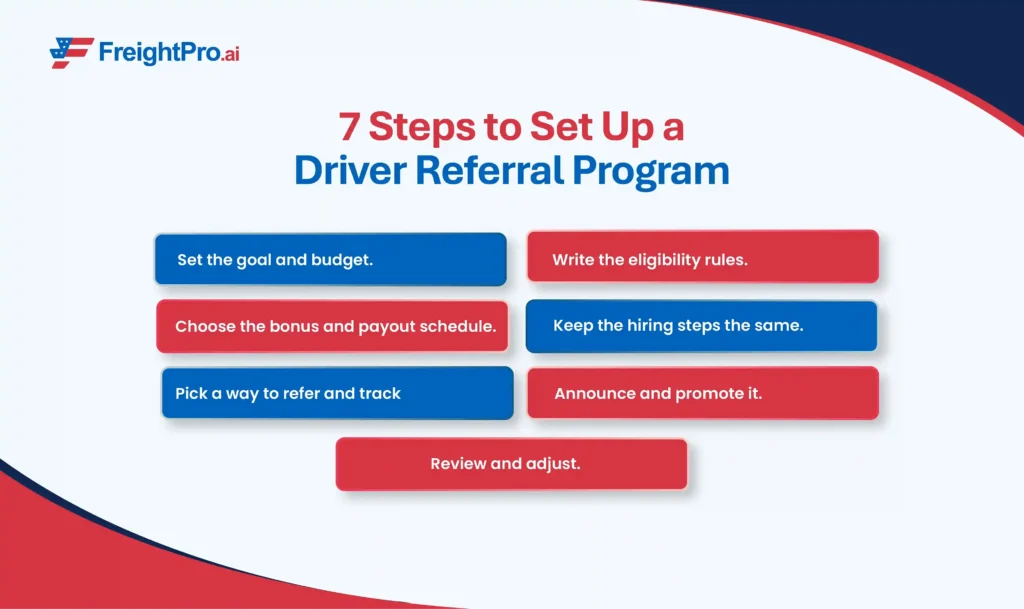
Seven steps cover it. Write each decision down before you announce anything, so drivers get one clear set of rules.
Step 1: Set the goal and the budget
Start with the driver profile you need and the most you will pay for a hire, because every other rule depends on those two decisions. Name the target: CDL-A, the run type (OTR, regional or dedicated), and any endorsements or equipment experience that matter.
Then add up what a hire costs you today from other sources: advertising, recruiter time, orientation, and any sign-on bonus. Your referral total should sit comfortably inside that figure, so use your own numbers on the cost of hiring a driver rather than a number from another carrier’s ad.
Step 2: Write the eligibility rules for your truck driver referral program
Eligibility rules decide who can earn the bonus in your truck driver referral program and what counts as a qualified referral. Settle these points in writing:
- Who can refer: current drivers in good standing, with a minimum time on the job such as 90 days.
- Who cannot: recruiters, dispatch managers, and anyone else who makes hiring decisions, since recruiting is already part of their pay.
- What counts: a CDL-A driver who has not applied with you recently, for example, in the past six months, and who completes your normal hiring process.
- Duplicates: whether the first documented referral wins or the bonus is split.
- Timing: the referral is logged before the candidate applies on their own.
Step 3: Choose the truck driver referral bonus and payout schedule
Pay the truck driver referral bonus in installments tied to how long the referred driver stays, so the payout follows retention instead of the hire date. A bonus paid in one lump sum on day one rewards the introduction but not the result.
Decide three things: the total amount, the milestones that trigger each installment, and how it is paid (through payroll or settlement, depending on how the referring driver is paid). Also write down what happens to unpaid installments if either driver leaves. The next section shows an example structure.
Step 4: Pick a simple way to submit a driver referral and track it
The easiest program to join is one a driver can use from the cab. Offer one or two options: a referral card with the referrer’s name and truck number, a text to a recruiting line, or a short online form.
Track every referral in one place. If you use recruiting software, add a source field for employee referral and a field for the referring driver; if not, a shared spreadsheet works. Acknowledge each referral to the referrer, so drivers know it is registered.
Match the tool to the fleet. An owner running a small fleet can manage the whole program from a spreadsheet and a phone, while a fleet with a recruiting team gets more from a source field in its tracking system, because referral hires then show up in the same reports as every other channel.
Step 5: Keep the hiring steps the same for every driver
A referral opens the conversation, and it never replaces a hiring step. Every referred driver completes your standard application, the previous-employer safety performance history investigation and motor vehicle record inquiry under 49 CFR 391.23, and a pre-employment query in the FMCSA Drug & Alcohol Clearinghouse before they perform safety-sensitive functions (49 CFR 382.701).
Keep what you learn in that process confidential. Under 49 CFR 391.23, information from previous employers may be used only as part of the hiring decision and must be protected from people not directly involved in it, so tell the referrer whether the driver was hired and when payouts are due, and nothing more.
Add one line to the policy: a referral does not guarantee a job offer.
Step 6: Announce it and keep it visible
A program driver does not know about earning nothing. Announce it with support from the owner or a senior leader, then keep it in front of drivers on a regular schedule:
- Hand a one-page summary to every driver at orientation, while they are still new to the fleet and the people they used to drive with.
- Cover it in safety and driver meetings, and send short reminders by text or app.
- Keep referral cards where drivers pick up paperwork, such as the terminal or dispatch office.
- Thank each referring driver personally when the referred driver starts.
Step 7: Review results and adjust
Review the program every quarter with four numbers: referrals submitted, referrals hired, referred drivers still employed at each payout milestone, and total bonus paid compared with your cost for other sources. Ask drivers what would make them refer more, and report back on what you changed.
Read the pattern before changing the bonus. Few submissions usually point to awareness or rules, while referred drivers who leave early usually point to the job itself, which is a question for how you improve driver retention, not for the bonus table.
What does an example driver referral bonus structure look like?
A staged structure pays the referring driver in three installments, at the referred driver’s start, at 90 days, and at 180 days, so most of the money follows retention.
The amounts below are an illustrative example, not an industry benchmark. Set yours based on your own cost per hire.
| Milestone | Trigger | Example payout | Purpose |
| Start | Referred driver completes orientation and runs a first dispatch | $500 | Rewards the introduction |
| 90 days | Referred driver is still employed | $500 | Rewards the stay through the early months |
| 180 days | Referred driver is still employed | $500 | Rewards a longer stay |
| Total | $1,500 | Paid over six months |
Staging is one of three common ways to structure a bonus. Pick the one that matches the driver profile you need:
| Structure | How it pays | Works best when | Trade-off |
| Staged | Installments at set milestones after the start date | You want the payout tied to retention | More tracking and payout dates to manage |
| Lump sum | One payment after orientation or a first dispatch | You want the simplest program to run | No retention incentive built in |
| Escalating | A higher bonus for each additional hire a driver refers within a quarter | You want to reward your most active referrers | Costs rise with success, so cap the budget |
Whatever you choose, pay exactly what the policy says, on the dates it says. A late or missing payout does more damage to the program than a small bonus does.
Why do driver referral programs stall?
Four problems account for most stalled programs, and each one has a direct fix:
- Rules drivers cannot repeat: If a driver cannot explain the bonus in a sentence, they will not mention it to a friend. Shorten the policy.
- Payouts that arrive late: Drivers talk. Pay on the dates you published.
- A single announcement: Promotion has to repeat across orientation, meetings, and texts.
- Using referrals as the only channel: They reach the circle your drivers already know, and that circle has limits.
What should you check before you launch?
Run the written policy past your payroll provider and employment counsel before you announce it. This is general information, not legal advice. Three points deserve a look:
- Payroll – The IRS lists bonuses among supplemental wages for employees, so referral bonuses for employee drivers belong in payroll. Ask your tax adviser how to handle owner-operators.
- Fair access to openings – Federal EEOC guidance has long cautioned that relying only on word-of-mouth recruiting can limit who hears about openings. Use referrals as one channel among several, and apply the same qualification standards to every applicant.
- Policy wording – Ask counsel to review forfeiture and repayment terms, since state wage rules may affect how you word them.
How do referrals fit with other ways to reach qualified CDL-A drivers?
Referrals reach the people your drivers already know, which is a small circle. Carriers that want access to qualified CDL-A drivers beyond that circle add other channels, such as a recruiting platform like FreightPro.
FreightPro is a recruiting technology platform for US carriers. Carriers filter by what the fleet needs, including experience, endorsements, equipment, run type, home time, pay, and location, and see relevant CDL-A driver profiles ranked by AI match. The matching is AI-powered, backed by our human team.
FreightPro does not run or pay referral programs. The rules, the bonus, and the tracking stay with your fleet, and a referral program works alongside any other way you find drivers.

Launch a driver referral program with one written page
Write the policy on one page: who can refer, what counts, how much is paid and when, and how a referral is logged. Stage the bonus, keep every hiring step the same for referred drivers, and review the numbers each quarter. Treat referrals as one sourcing channel among several, and the program strengthens your hiring without becoming its only source.
Questions about FreightPro for your fleet? Contact the FreightPro team.
Frequently asked questions
1. How much should a trucking company pay for a driver referral bonus?
There is no required amount. Set the total bonus with your own cost per hire in view, then pay it in installments tied to how long the referred driver stays. A total that fits your budget and that drivers find worth a phone call works better than a number copied from another carrier.
2. Can owner-operators join my driver referral program?
Yes, if your written policy says so. Decide whether owner-operators can refer drivers, be referred, or both, and state it in the rules. Payment and tax reporting can differ for owner-operators and employee drivers, so ask your payroll provider or tax adviser how to handle each.
3. Do I still need a Clearinghouse query for a driver my own driver referred?
Yes. A referral does not change federal hiring requirements. Before you hire a driver to perform safety-sensitive functions, you must run a pre-employment query in the FMCSA Drug & Alcohol Clearinghouse, and the driver must give electronic consent for the full query. A recommendation from a current driver is not a substitute.
4. Should I pay the referral bonus if the referred driver quits early?
Pay only the installments the referred driver’s time with your fleet has earned under your written policy. Later installments stop when that driver leaves. State this rule before launch, and have employment counsel review any repayment terms, since wage rules may vary by state.
5. What happens if two drivers refer to the same person?
Decide this before launch and write it down. Two common options are paying the first documented referral or splitting the bonus between both drivers. Whichever you choose, log every referral with a date before the candidate applies, so the record settles any dispute.
6. Can I offer something other than cash as a truck driver referral bonus?
Yes. Some carriers offer extra paid time off, gift cards, or scheduling priority instead of cash or alongside it. Cash is the simplest to administer. If you choose non-cash rewards, ask your payroll provider how they are taxed and reported before you promise them in the policy.