
Hiring owner-operators lets a small carrier add trucks without buying them, but few owner-operators apply, and every one you sign needs a lease that follows the federal truth-in-leasing rules.
If you want to hire owner-operators, choose your lease-on model and lanes, set percentage pay, prepare the lease agreement, review each application, then complete the signed lease and receipt of equipment. This guide walks through each step, including the driver qualification file you still keep for a leased-on owner-operator, and how to find relevant CDL-A driver profiles when applications are scarce.
| TL;DR 1. To hire owner-operators, decide the lease-on model and lanes first, then set percentage pay, prepare a compliant lease agreement, review each application, and complete the signed lease and receipt of equipment. 2. Federal truth-in-leasing rules (49 CFR 376.12) set what your owner-operator contract must say about compensation, chargebacks, insurance, and escrow. 3. A leased-on owner-operator runs under your authority, so you still keep a driver qualification file and apply your drug and alcohol testing program. 4. When applications are scarce, FreightPro gives you access to qualified, relevant CDL-A driver profiles to review against your lanes and pay. |
What is an owner-operator, and which kind can a small carrier lease on?
An owner-operator is a CDL driver who owns or finances the tractor they drive. A small carrier usually works with a leased-on owner-operator, who runs under the carrier’s operating authority and DOT number, rather than an independent owner-operator who holds their own authority and books their own freight.
The difference shows up in your paperwork and risk. With a leased-on owner-operator, your authority, your insurance obligations, and your driver qualification file all apply. That is why the lease, the pay sheet, and the application review below each need to be written down.
Owner-operator vs company driver: what changes for your fleet?
A company driver operates your truck for wages while you carry the equipment costs.
A leased-on owner-operator brings their own tractor and is paid a share of revenue or a per-mile rate. They cover most operating costs, while you retain the authority, insurance obligations, and compliance file.
| Topic | Company driver | Leased-on owner-operator |
| Tractor | Your truck | The operator’s own or financed truck |
| Pay | Per mile, hourly, or salary | Percentage of revenue or a per-mile rate, as written in the lease |
| Fuel and maintenance | You pay | Usually the operator, as the lease states |
| Operating authority | Yours | Yours, for the length of the lease |
| Public liability insurance | You maintain it | You maintain it, and the lease must say so |
| Driver qualification file | You keep it | You keep it, with the same core requirements |
| Tax status | W-2 employee | Independent contractor, subject to classification rules |
| Dispatch control | Your dispatch directs the work | Set in the contract; heavy control raises classification risk |
As Heavy Duty Trucking explains, once an owner-operator leases on, the carrier becomes responsible for the driver qualification file.
The recruiting side changes too. Owner-operators evaluate you like a business partner, so they compare revenue per mile, settlement terms, and lane consistency before they compare anything else.
How to hire owner-operators as a small carrier
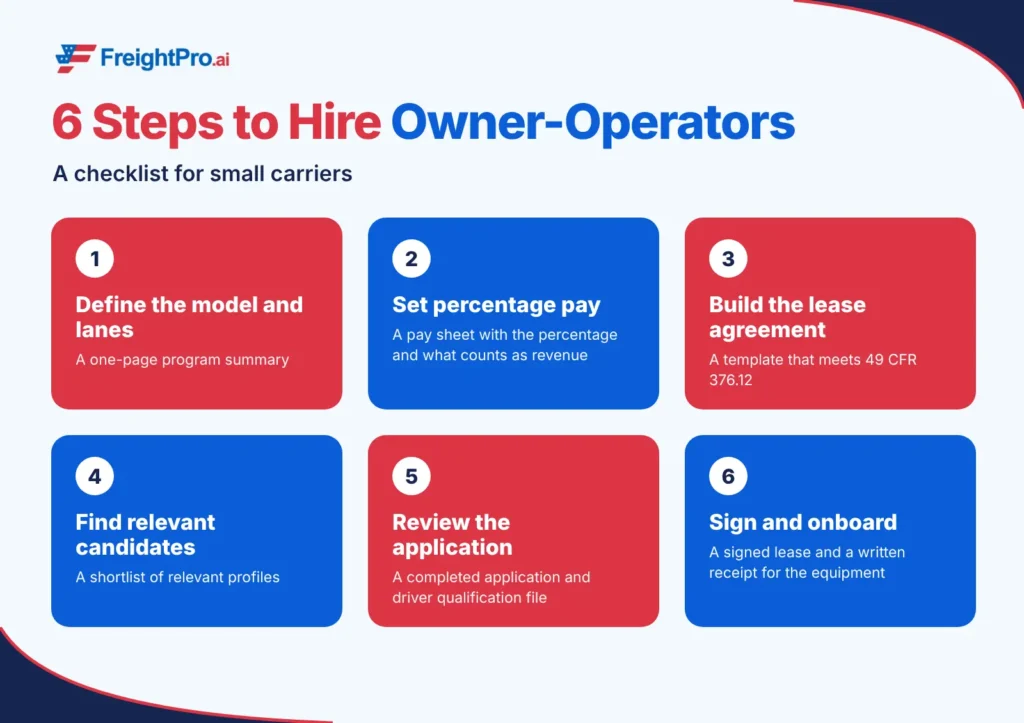
Hire owner-operators in six steps: choose the lease-on model and lanes, set percentage pay, prepare a compliant lease agreement, find relevant candidates, review each owner-operator application, then sign the lease and complete the receipt of equipment.
Each step produces a document you need before the truck moves.
| Step | Decision | What you produce |
| 1 | Lease-on model and lanes | A one-page program summary |
| 2 | Pay structure | A pay sheet with the percentage and what counts as revenue |
| 3 | Lease and operating agreement | A template that meets 49 CFR 376.12 |
| 4 | Where candidates come from | A shortlist of relevant profiles |
| 5 | Application review | A completed application and driver qualification file |
| 6 | Signing and onboarding | A signed lease and a written receipt for the equipment |
Step 1: Decide the lease-on model and the lanes
Start with the freight, not the truck. Write down the lanes, the trailer type, the home time you can offer, and who dispatches the loads.
Decide whether the operator pulls your trailer or their own, because the percentage you offer should reflect who supplies the trailer. Set minimum tractor standards in the same document, such as model year and equipment condition.
Step 2: Set owner-operator percentage pay
Owner-operator percentage pay gives the operator a fixed share of each load’s revenue, and the carrier keeps the rest. Set the percentage by lane, equipment, and who supplies the trailer, and write it down before you talk to candidates.
What counts as revenue is where most pay disputes start. Gross revenue can include fuel surcharge, detention, and stop pay, so your pay sheet should say which of those sit inside the percentage and which are paid separately.
Example: a 600-mile load with $2,000 in linehaul revenue and no accessorials.
| Operator percentage | Paid to operator | Per loaded mile | Kept by carrier |
| 70% | $1,400 | $2.33 | $600 |
| 72% | $1,440 | $2.40 | $560 |
| 75% | $1,500 | $2.50 | $500 |
Operator figures are before fuel, insurance, truck payment, and maintenance. Run the same math on your own lanes before you publish a percentage.
Percentage pay moves with the market, so the operator earns more when rates rise and less when they fall. Per-mile pay is steadier, and some carriers offer operators a choice between the two. If your lease pays a percentage of revenue, federal rules also require you to give the operator a rated freight bill copy at or before settlement.
Step 3: Build the owner-operator lease agreement
A compliant owner-operator lease agreement is a written lease, signed by both parties, that contains the provisions listed in 49 CFR 376.12. Searchers use owner-operator contract, owner-operator agreement, and owner-operator lease agreement interchangeably.
In practice, most carriers use one document that covers both the business terms and the federal lease terms.
| Required provision | What your agreement must do |
| Exclusive possession and control (376.12(c)) | State that the carrier has exclusive possession, control, and use of the equipment for the lease term, and assumes responsibility for its operation |
| Compensation (376.12(d)) | Specify what the operator is paid and how it is calculated, whether percentage, per mile, or flat rate |
| Payment timing (376.12(f)) | Set payment within 15 days after the operator submits the required delivery documents |
| Chargebacks (376.12(h)) | List every item you may deduct, explain how each amount is computed, and give the operator the documents needed to check the charge |
| No required purchases (376.12(i)) | State that the operator is not required to buy or rent products, equipment, or services from you as a condition of the lease |
| Insurance (376.12(j)) | Specify your legal obligation to maintain insurance coverage for the protection of the public. |
| Escrow (376.12(k)) | If you require escrow, state what the funds can be applied to and provide an accounting. |
Have a trucking attorney review the final template. The lease is also where you decide who removes your markings from the truck when the relationship ends.
Step 4: Start owner-operator recruiting and find candidates
Owner-operator recruiting works best when you lead with the lane, the pay sheet, and the settlement schedule. Operators decide on revenue and terms before anything else, so a vague offer loses them early.
Start with the people already near your freight:
- Your own company drivers who are weighing a truck purchase or financing deal
- Referrals from owner-operators already running on your authority
- Shippers and brokers who know which operators run your lanes well
- Driver communities and local meetups in the regions your lanes cover
Step 5: Review the owner-operator application
An owner-operator application collects the same driver information every CDL applicant provides, plus business details about the truck, the trailer, and the insurance the operator carries.
Treat the two parts separately: the driver file is regulated, and the business questions are your own judgment.
| Item | Your step as the carrier |
| Driver application (49 CFR 391.21) | Collect it and keep it in the driver qualification file |
| Motor vehicle record (391.23) | Obtain and review it before the operator drives for you |
| Road test or CDL copy (391.31) | Record the road test certificate or keep a copy of the CDL |
| Medical certificate (391.41) | Confirm it is current and file a copy |
| Drug and alcohol program (Part 382) | Run pre-employment testing and Clearinghouse steps under your program |
| Tractor and trailer | Ask for model year, equipment condition, and trailer type against your minimums |
| Insurance | Ask for certificates for the coverage your lease requires the operator to carry |
| Lanes and references | Match the operator’s preferred lanes and home time to your program |
Step 6: Sign the lease, take the receipt, and onboard
Complete the signature, the written receipt for the equipment, and a copy of the signed lease for the operator before the truck runs a load. Identify the equipment with your name and DOT number for the length of the lease.
Then walk the operator through the settlement schedule and how percentage pay appears on a statement.
Does an owner-operator lease make the driver an independent contractor?
No. The lease alone does not decide worker status. Law firm Benesch notes that the lease’s exclusive control language does not by itself create employee status, and that the question is typically decided under federal and state labor tests.
Those tests are in motion. In February 2026, the Department of Labor proposed rescinding the 2024 standard, with comments closing April 28, 2026. Check the Federal Register for whether a final rule has been issued since.
State law can still control. If you operate in California, AB 5 still governs your owner-operator relationships regardless of the federal proposal. Day-to-day control also matters: if a carrier exerts significant control over an owner-operator’s schedule or routes, the Labor Department may view them as an employee, whatever the signed agreement says. This is not legal advice, so confirm your structure with employment counsel.
Where does FreightPro fit when you want to hire owner-operators?
FreightPro is a recruiting technology platform that gives carriers access to qualified, relevant CDL-A driver profiles. There are 120K+ CDL-A drivers on FreightPro, and the platform is built around the quality and relevance of the profiles you see, not the quantity of activity.
You sign up and filter by what your fleet needs: experience, endorsements, equipment, run type, home time, pay, and location. FreightPro then ranks relevant CDL-A driver profiles by AI match, with a match score on each, using 25+ AI match criteria. It is AI-powered matching, backed by our human team.
Here is what that looks like in practice:”, and cover:
- filtering by experience, endorsements, equipment, run type, home time, pay, and location
- the match score on every profile
- reviewing each profile before you contact anyone
- support from the human team in refining your criteria
When a profile looks like the right fit, you can unlock it to get the driver’s phone number and call. Drivers may be on the road or hauling when you call, so plan to follow up.
Before you sign your first owner-operator lease
Write three things before you talk to any candidate: the one-page program summary, the pay sheet, and the lease template. Have an attorney review the lease against 49 CFR 376.12, and decide in advance how you will handle the driver qualification file and drug and alcohol testing for leased-on operators.
Owner-operators reward carriers that are specific. A clear lane, a clear percentage, and a clear settlement schedule give the few qualified applicants you get a reason to say yes.
Frequently asked questions
1. How do owner-operators get paid?
Most leased-on owner-operators are paid a percentage of the revenue on each load, a rate per mile, or a flat rate per load. The carrier then deducts agreed charges such as fuel, insurance, or escrow, and the lease must spell those deductions out. Settlements are usually weekly or biweekly, so state the schedule in writing.
2. How does owner-operator percentage pay work?
There is no fixed percentage, because it depends on who pays for fuel, equipment costs, insurance, and other expenses. The split is set in the lease and varies by carrier, lane, and equipment. What matters is that the operator can see exactly what the percentage covers before signing anything.
3. What is the difference between an owner-operator and a company driver?
An owner-operator owns or leases the truck and usually runs as an independent contractor, while a company driver drives a carrier-owned truck as an employee. The owner-operator carries truck costs and earns a share of revenue. The company driver gets a wage and benefits, and the carrier carries the equipment costs.
4. What is an owner-operator contract or owner-operator agreement?
It is the written contract that lets a carrier use an owner-operator’s truck under its authority. Federal truth-in-leasing rules require it to cover the term, compensation, who pays which costs, insurance, escrow, and termination. Both parties sign it, and the operator keeps a copy before the truck runs.
5. What should an owner-operator application include?
You need a current CDL-A, a roadworthy tractor, proof of insurance, and a signed lease before dispatch. You also complete the driver qualification file, including the application, motor vehicle record, and drug and alcohol testing steps. Have a trucking attorney review your lease template against federal rules before using it.
7. Do owner-operators need their own authority?
Not always. A lease-on owner-operator runs under your operating authority, so they do not need their own. An operator with their own authority hauls under their own MC number and usually works with you as a contracted carrier instead. Decide which model you want before you write the program.