

Research tracking more than 62,000 drivers found that 70% of turnover happens in the first year, and half of those drivers leave within the first three months.
For fleets running 5 to 50 trucks, that makes truck driver retention a hiring and onboarding problem first, and with federal licensing and English-proficiency enforcement narrowing the qualified CDL-A pool in 2026, each departure is harder to replace with the right driver.
This guide gives seven fixes for small fleets, from hiring for lane, equipment, and home-time fit to running the first 90 days, with the evidence behind each and what to change this month.
| TL;DR 1. Truck driver retention at a small fleet is mostly decided in three places: the hiring conversation, the first 90 days, and daily contact with dispatch. 2. Research tracking more than 62,000 drivers found 70% of turnover happens in the first year, and half of those drivers leave within the first three months. 3. The lowest-cost retention fix is hiring a CDL-A driver whose lanes, equipment, and home-time needs already match your freight. 4. Small fleets hold a real edge because the owner is close enough to drivers to fix a missed home date, a short settlement, or a dispatch problem directly. |
Research tracking more than 62,000 drivers found that 70% of turnover happens in the first year, and half of those drivers leave within the first three months.
For fleets running 5 to 50 trucks, that makes truck driver retention a hiring and onboarding problem first, and with federal licensing and English-proficiency enforcement narrowing the qualified CDL-A pool in 2026, each departure is harder to replace with the right driver.
This guide gives seven fixes for small fleets, from hiring for lane, equipment, and home-time fit to running the first 90 days, with the evidence behind each and what to change this month.
What is truck driver retention?
Truck driver retention is a fleet’s ability to keep the CDL-A drivers it hires, usually tracked as the share of new drivers still employed at 90 days and at 12 months. Truck driver turnover is the reverse: the annualized rate at which drivers leave and are replaced.
Turnover in truckload has run high for decades. American Trucking Associations data shows smaller truckload fleets have historically posted a lower truck driver turnover rate than large carriers, but not by as much as most owners assume.
| Fleet segment (ATA definition) | Long-run average annual turnover | Period measured |
|---|---|---|
| Large truckload (over $30M revenue) | 92.7% | Q3 1996 to Q1 2023 |
| Less-than-truckload (LTL) | 11.8% | Q4 2000 to Q1 2022 |
At a 77.6% rate, a 20-truck fleet makes about 15 replacement hires in a typical year. Those departures rarely spread evenly. They cluster in the same few trucks, which is why the first months of employment get so much attention below.
Why does truck driver retention matter more for small fleets in 2026?
Truck driver retention matters more in 2026 because replacing a driver has become harder and more expensive.
- Retention is back on the industry’s radar – In ATRI’s 2026 Top Industry Issues report, released October 18, 2026, driver retention ranked 10th overall, up from 14th the year before. Motor carriers ranked it 6th.
- The non-domiciled CDL rule is in force – FMCSA’s final rule took effect March 16, 2026, and limits non-domiciled CDLs to H-2A, H-2B, and E-2 status holders. A court challenge was still undecided as of mid-October 2026.
- English-proficiency enforcement is steady – Since June 2025, roadside out-of-service orders for English proficiency have sidelined about 2,000 drivers a month, according to an ATA safety policy executive quoted by Transport Topics.
- Drivers are squeezed too – ATRI’s 2026 operational cost update found driver wages rose 2.5% in 2025 against 2.7% inflation, the second straight year they paid trailed prices.
For a small fleet, the conclusion is practical. The qualified drivers already on your trucks are the hardest drivers to replace this quarter, and keeping them costs less than finding their successors. The most cited study, from the Upper Great Plains Transportation Institute, put the average cost of replacing a truckload driver at $8,234, based on 1998 data.
7 truck driver retention strategies for small fleets
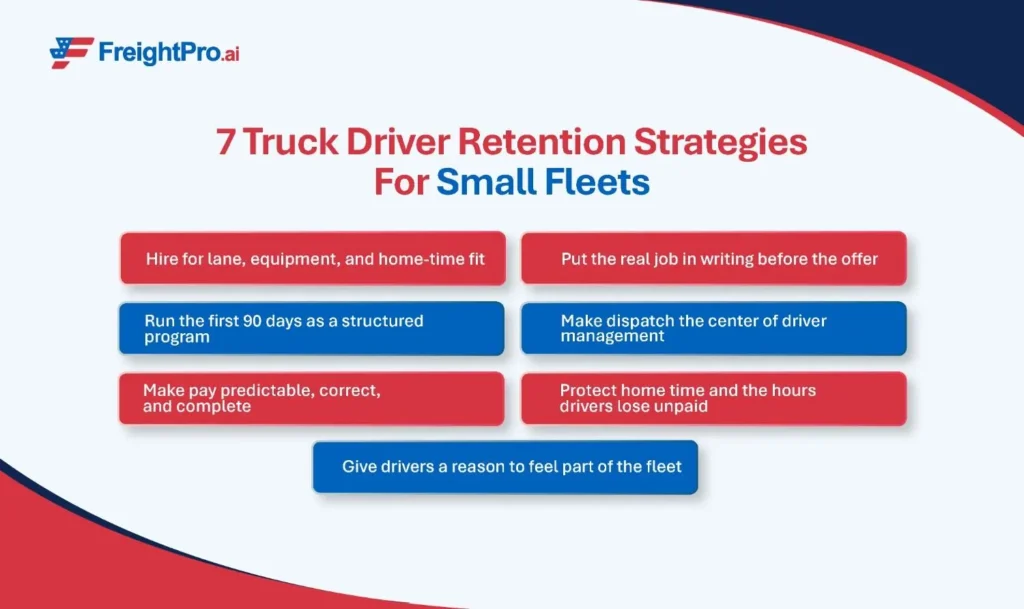
The 7 strategies below run in the order a driver experiences your fleet: hiring, offer, first 90 days, daily dispatch, pay, home time, and belonging. Most turnover happens early, so the first three carry the most weight.
1. Hire for lane, equipment, and home-time fit
The first retention decision happens before a driver’s first day: whether the job matches how that driver wants to run. In Stay Metrics research reported by CCJ, 93.4% of drivers who quit within 90 days were home less than they expected. A fit problem at hiring shows up as turnover within weeks.
When applications are scarce and qualified ones scarcer, the pull is to hire whoever clears the DQ file review and get the truck moving. That trade often costs more than the idle week it saves. Strong recruiting is what keeps a small fleet operationally stable, because every poor-fit hire restarts the cycle.
Before you review a single application, write a fit profile for each truck:
- Lane and run type: local, regional, OTR, or dedicated, plus typical weekly miles.
- Home-time pattern: daily, weekends, or a set number of days out.
- Equipment and endorsements: dry van, reefer, or flatbed; Hazmat, Tanker, or Doubles/Triples if the freight needs them.
- Pay model: CPM, percentage, or hourly, with realistic weekly gross.
Then ask every candidate what their last home-time schedule was, why they left their last carrier, and which freight they will not haul. Recruiting platforms that let carriers filter driver profiles by run type, equipment, and home-time expectations, such as FreightPro, make this fit check part of sourcing instead of something discovered in week three.
2. Put the real job in writing before the offer
Give every candidate a written, realistic preview of the job before they accept: miles, home time, pay math, detention policy, and equipment. In a CCJ survey of fleet managers, 40% named mismatched job expectations as the main reason new drivers quit, ahead of every other cause.
Recruiters at small fleets often describe the best week on the lane. Drivers quit over the average week. A one-page job preview fixes that.
| What to state in writing | Example of the level of detail drivers need |
|---|---|
| Average weekly miles and range | 2,200 to 2,600 miles in a normal week; 1,800 in a slow one |
| Home-time pattern | Home every Friday night to Monday morning; one missed weekend per quarter is possible |
| How pay is calculated | CPM by practical miles, plus stop pay, layover pay, and detention after 2 hours |
| Equipment | Truck model year, governed speed, APU or inverter, trailer type |
| A typical bad week | Two long detentions at one shipper, a reload that pushes home time by a day |
If you can, let the candidate talk to a current driver on the same lane for 15 minutes. Honest answers from a peer do more for retention than any recruiting pitch.
3. Run the first 90 days as a structured program
Treat the first 90 days as a planned program with scheduled check-ins, not a probation period the driver has to survive. Stay Metrics data on more than 62,000 drivers found that 70% of turnover happens in the first year, with half of those drivers leaving in the first three months. Day 45 stood out as a warning point.
Most small fleets already talk to new drivers every day. What is usually missing is a set moment to ask the harder questions before a frustration hardens into a decision.
| Check-in | Who | What to ask or do |
|---|---|---|
| Day 1 | Owner or ops manager | Welcome call, introduce dispatch, confirm the first home-time date |
| Day 7 | Recruiter | Does the job match what you were told? What surprised you? |
| Day 30 | Payroll or owner | Walk through the first settlements line by line |
| Day 45 | Owner | Home time kept? Dispatch working? Anything that would make you look elsewhere? |
| Day 90 | Owner and dispatcher | Review miles, pay, and home time against the job preview; agree on any changes. |
The owner making the day-45 call personally is one of the clearest advantages a 10-truck fleet has over a 1,000-truck carrier. Use it.
4. Make dispatch the center of driver management
For most drivers, the dispatcher is the company. Stay Metrics found that high dispatcher satisfaction was associated with about 16% lower early turnover, and high recruiter satisfaction with about 22% lower. Good driver management means setting standards for how dispatch communicates instead of leaving it to personality.
At many small fleets, the owner dispatches, or one dispatcher covers every truck. That makes a few written standards more important, not less:
- A return-call window drivers can count on, including evenings.
- No reload that pushes past a home-time date without asking the driver first.
- A reason given with every load change, even a short one.
- A weekly 10-minute call with each driver that is not about the current load.
Track driver complaints about dispatch the same way you track late deliveries. A pattern with one dispatcher is a retention problem you can see coming months ahead.
5. Make pay predictable, correct, and complete
Pay level matters, but so does whether a driver can predict and trust the settlement. Truck drivers in ATRI’s 2026 survey ranked compensation among their top three concerns. Small fleets that cannot lead on rate can still lead on clarity, accuracy, and paying for time drivers currently give away.
- Show the math: Break every settlement into miles, rate, accessorials, and deductions so a driver can check it in two minutes.
- Fix errors in the same pay cycle: A short check that waits two weeks for correction tells a driver where they rank.
- Pay for waiting: Detention after two hours, layover pay, and breakdown pay protect weekly income on bad weeks.
- Set a weekly floor: A minimum weekly guarantee for drivers who run the loads dispatched to them takes the worst weeks off the table.
If you use a sign-on or retention bonus, pay it in installments tied to tenure rather than up front.
6. Protect home time and the hours drivers lose unpaid
Home time promised has to be home time delivered. Drivers in ATRI’s 2026 survey ranked truck parking second and detention at customer facilities seventh among their concerns, and both eat into hours and home time. Plan loads backward from the home-time date, and treat a missed date as an incident to review.
Practical steps for a small fleet:
- Plan the last two loads before a home-time date first, then fill the rest of the week around them.
- Avoid booking freight from shippers with a pattern of long detention on loads that end a driver’s week.
- Pre-plan overnight parking on known tight corridors so drivers are not burning clocks looking for a spot.
- Track a simple “home time kept” rate per driver each month. Below 90% is an early warning.
7. Give drivers a reason to feel part of the fleet
Drivers who feel known by the company and connected to other drivers give a fleet more room on a bad week. In Stay Metrics research covered by HDT, drivers with a negative view of their fleet were more likely to quit regardless of tenure. Small fleets can build belonging on purpose.
- Pair each new hire with a mentor driver on a similar lane for the first 90 days, and pay the mentor a small stipend.
- Give drivers direct access to the owner, with a standing monthly call or a visit at the yard.
- Recognize safe miles and tenure milestones where other drivers can see it.
- Ask drivers before you spec new equipment. The people in the cab notice what the spreadsheet misses.
Plenty of drivers also find community outside the company, in driver forums and apps such as FreightPro, where they share routes, truck stops, and local meetups. A fleet that respects that life on the road, instead of competing with it, reads as a better place to stay.
How should a small fleet measure driver retention?
Measure driver retention with a few numbers you review monthly, split by hire date, so problems show up while you can still act. Annual turnover alone hides the early losses that drive most of the cost.
| Metric | What it tells you |
|---|---|
| 90-day retention rate | Whether hiring fit, job previews, and onboarding are working |
| 12-month retention rate | Whether pay, dispatch, and home time hold up past the first season |
| Annualized turnover | How you compare with the ATA segment averages above |
| Home time kept (%) | Whether dispatch is delivering what the offer promised |
| Settlement corrections per month | Whether pay is trusted |
| Truck driver satisfaction score (day 7, day 45, then quarterly) | Where frustration is building before it shows up as a notice |
| Coded exit reasons | Which of the seven areas to fix first |
Where should a small fleet start?
Small fleets rarely need a formal truck driver retention program to see results. Start with the first 90 days and the hiring decision behind them, because that is where most driver turnover happens. Write a fit profile for your next hire, put the job preview on one page, and book the day-45 call on the calendar before the driver’s first load.
Pay, home time, and belonging matter for every driver, but they will not hold a driver who should not have been hired for that lane. Get fit right first, then make the rest of the job match what you promised.

Frequently asked questions
1. What is a good driver retention rate for a small trucking company?
There is no official benchmark, but ATA’s long-run average annual turnover for smaller truckload fleets is about 78%. A small fleet holding turnover well below that is outperforming its segment. Track 90-day retention separately, because the first three months are where most drivers leave.
2. Do sign-on bonuses help keep truck drivers?
Not on their own. A sign-on bonus pays a driver to start, not to stay, and drivers who leave over home time or dispatch problems leave anyway. If you use one, pay it in installments tied to tenure, such as 30, 90, and 180 days, alongside an accurate job preview.
3. How do I calculate my truck driver turnover rate?
Divide the number of drivers who left during a period by your average driver count for that period, then multiply by 100. To annualize a quarterly figure, multiply by four. Example: 3 departures from an average of 15 drivers in a quarter is 20%, or 80% annualized.
4. Why do experienced truck drivers leave a new carrier in the first few months?
Usually because the job did not match what they were told. Experienced drivers know what they want, and Stay Metrics found drivers with at least one year in the industry were slightly more likely to quit early than newer drivers. Home time, miles, or pay that differ from the offer are common triggers.
5. Can a small fleet compete with large carriers on driver pay?
Yes, more closely than many owners expect. ATRI found per-mile wages at 26-truck fleets were only about 4.5 cents below those at 1,000-truck fleets in 2025. Small fleets can then compete on what large carriers find harder to offer: owner access, consistent lanes, and home time that is kept.
6. Should I do exit interviews with truck drivers who quit?
Yes, but hold the conversation before the driver’s last day and have someone other than their dispatcher lead it. Code each reason, such as home time, pay, dispatch, or equipment, so patterns show up across a year. Drivers tend to speak more openly with someone outside their daily chain.