Driving keeps you alone for most of the day, and research links that isolation to stress and weaker mental health. The fix is to pick two or three communities that match your CDL class, run type, and goals, and use each one for a specific job.
This guide covers where drivers connect, how to share tips other drivers can trust, and how to turn conversations into better pay, home time, and jobs.
| TL;DR 1. A truck driver community is any group of CDL holders who share road knowledge, job information, and support, online or in person. 2. Spending long hours alone is linked to stress and weaker mental health, and a community gives you people who understand the job. 3. Use different communities for different jobs: groups and forums for questions, associations for mentoring, a trucker community app, and meetups for people near you. 4. Treat every tip as a starting point, share your CDL class, equipment, and region when you ask, and check rules with FMCSA or your state agency. |
What is a truck driver community?
A truck driver community is a group of CDL holders who share road knowledge, job information, and support with each other. It can meet online in a forum, Facebook group, or app, or in person at a truck stop, a driver association event, or a local meetup. Class A, B, and C drivers, and owner-operators, all have communities.
Communities differ by purpose. Some exist to answer questions, some to share job openings, and some simply to give you company at 2 a.m. Most drivers end up in more than one.
If you drive local, look for groups built around your city, yard, or shift. If you drive long-haul, look for groups built around a road, a region, or a shared background.
Why do truck drivers need a community?
Because the job keeps drivers alone for most of the day, and research links that isolation to stress and weaker mental health. A community gives you people who know what a 34-hour restart, a slow dock, and a full lot feel like. It also gives you a place to compare notes on problems every driver faces.
Researchers keep finding the same thing. A 2016 study of long-haul drivers found that social isolation and the difficulty of keeping meaningful ties on the road take a toll on mental health. The abstract adds that truckers struggle with loneliness and are overstressed from work pressures and weak support systems.
A 2024 study of 32 drivers at a Western European company found that drivers coped through different layers of their network. Talking with close friends at work reduced stress and loneliness. The sample is small and European, so read it as a pattern worth noting, not a US statistic.
Drivers also share problems that are easier to carry together. In the 2025 ATRI industry survey of more than 4,200 respondents, drivers ranked compensation, truck parking and English language proficiency as their top concerns. On parking, professional driver Emily Plummer told CCJ, “I can go out there and put my truck anywhere, but am I safe?”
CalMatters reporting from August 2026 shows how drivers build community on their own. Fresno driver Gurinderjit Singh joins long calls with fellow drivers and says they can reduce stress, social isolation, and loneliness. The story notes that drivers use headsets to stay legal and hang up in heavy traffic.
Where do truck drivers connect with each other?
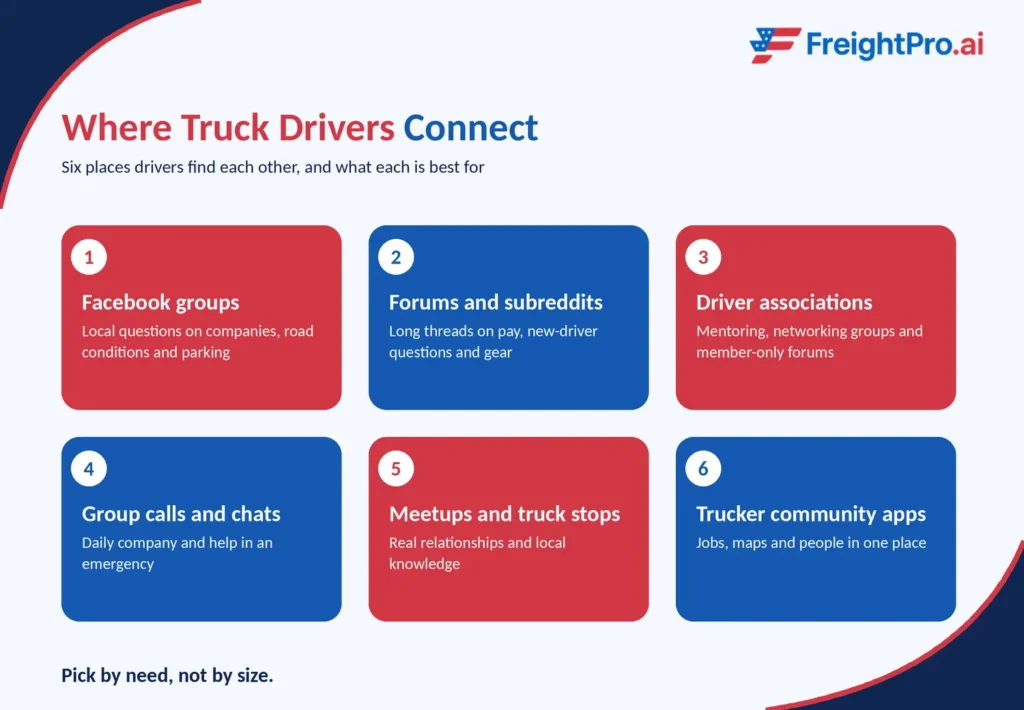
Drivers connect in six main places: social media groups, forums and subreddits, driver associations, group calls and chats, in-person gatherings, and trucker apps.
Each suits a different job. Groups and forums answer questions, associations offer mentoring, calls give daily company, and apps add jobs, maps and local meetups.
| Where | Best for | Watch for |
| Facebook groups | Questions about companies, road conditions and local parking | Old posts, unmoderated advice and spam |
| Forums and subreddits such as r/Truckers | Long threads on pay, new-driver questions and gear | Anonymous accounts, so check claims before acting |
| Driver associations | Mentoring, networking groups and member-only forums | Membership dues and a specific focus, so check the fit |
| Group calls and chats | Daily company and help in an emergency | Hands-free and legal use only, and never while driving in traffic |
| Truck stops, events and local meetups | Real relationships and local knowledge | Hard to schedule around a tight run |
| Trucker community apps | Jobs, maps and people in one place | Moderation, privacy settings and what the app really offers |
Associations add structure. The Women In Trucking Association lists a member-only forum, a mentoring program, networking groups, and a member directory among its member benefits.
Pick by need, not by size. A huge group with no moderation can serve you worse than a small local group that knows your lanes.
What should a trucker community app offer?
A good trucker community app puts drivers first: real profiles, a feed you can follow, a way to find drivers nearby, and tools you actually use on the road. Check who runs it, how it handles privacy, and whether it works on your phone at a truck stop.
Social media for truck drivers works best when the feed is built around the job. Look for these features before you commit your time:
- Profiles that show experience, endorsements, equipment, and run type.
- A feed with posts and short videos that you can follow by driver, owner-operator, or company.
- A way to see drivers nearby and join local meetups.
- Road tools in the same app, such as truck navigation and parking information.
FreightPro is one example of a social network for truck drivers. Its social feed carries posts and short videos from drivers, owner-operators, and companies you follow; Meet shows drivers nearby, and local meetups bring the conversation off the phone.
The same app has truck-focused navigation, truck stops on the map, and weigh station status and truck parking availability reported by drivers.

How do truck drivers share tips that other drivers can trust?
Share tips with the details another driver needs: your CDL class, equipment, state or lane, and the date. Ask questions the same way.
Treat every answer as a starting point, then check rules against FMCSA or your state agency and check pay or policy claims against your own paperwork.
| What you want to know | Ask in | Check it with |
| Whether a lot is safe overnight | Local groups and apps with driver-reported parking | The date of the report and your own look on arrival |
| Weigh station or road conditions | Apps with driver reports and state groups | State DOT sites and your navigation |
| A company’s pay and home time | Drivers who work or worked there | The written offer and a sample pay sheet |
| Whether a rule applies to you | Experienced drivers and associations | FMCSA, your state licensing agency and your carrier’s safety team |
Keep your safety in mind when you post. A fleet CEO cited in CCJ’s ATRI coverage said his company has seen more cargo theft attempts on trucks parked outside traditional lots. Share a lot after you have left it, and keep load details out of public posts.
How can a driver community help your career grow?
A driver community can help you grow your career through mentorship, firsthand information about employers, and word-of-mouth referrals for job openings. You can get more value from these communities by:
- Make better job decisions: Before switching companies, ask drivers who already work there about pay structure, home time, equipment age, and how dispatch treats them. Compare their feedback with the written offer. If you’re weighing pay against home time, read our guide to high-paying OTR CDL jobs with weekly home time.
- Keep your driver profile updated: List your driving experience, endorsements, equipment, preferred run types, and home-time expectations wherever you have a driver profile. Our guide to building a strong CDL driver profile explains what to include.
- Connect with drivers in your category: CDL-B and CDL-C drivers should look for communities focused on their equipment and local areas, such as straight truck, bus, passenger, and local-run groups. Owner-operators can benefit from connecting with peers who operate similar equipment and run similar lanes.
- Learn from experienced drivers: Ask questions, share your experiences, and learn from drivers who have already worked with different carriers. Their firsthand advice can help you avoid poor job decisions and identify better opportunities.
How do you get started in a truck driver community this week?
Pick one community for the problem you have today, read it for a few days, then introduce yourself with your CDL class, equipment, run type, and region. Answer one question a week, and go to one in-person gathering when your schedule allows. Small, steady use beats joining ten groups.
- Name your biggest problem right now: parking, pay, home time, a first job, or loneliness.
- Join one group, forum, or app that fits it, and read the rules before you post.
- Introduce yourself with the details other drivers need to help you.
- Add a second community for a different need, such as a local meetup or a mentoring program.
Which truck driver community should you join first?
Join the one that solves your biggest problem today, then add a second for a different need. Use groups and forums for questions, an association for mentoring, and an app or meetup for people near you. A few active communities will do more for your career than a dozen you never open.
Pick one community this week, read it for a few days, and ask your first question with your CDL class, equipment, and region.

Frequently asked questions
1. Can I join a truck driver community if I just got my CDL?
Yes, most communities welcome new drivers, and many are most useful early in a career. Read for a few days to learn each group’s rules, then introduce yourself with your CDL class and region. Ask specific questions about companies, equipment, and parking, and look for mentoring programs run by associations.
2. Is a trucker community app free to use?
Most are free to download, though some include paid features, so check what you get before paying. Facebook groups and subreddits cost nothing, while associations such as Women In Trucking charge membership dues for forums, mentoring, and events. Never pay a stranger for access to a group.
3. How do I find trucker meetups near me?
Search local trucking groups and association chapters for event posts, then check any app with a nearby-drivers or meetups feature. Truck stops and driver appreciation events also post gatherings. Confirm the time and place with the organizer, and meet somewhere public with other drivers around.
4. What is the difference between a trucker forum and a social network for truck drivers?
A forum organizes conversation by topic, so you search threads for answers. A social network for truck drivers is built around people: profiles, a feed you follow, and often tools to find drivers nearby. Forums suit research, and networks suit ongoing relationships and local connections.
5. Do truck drivers still feel lonely when they drive as a team?
Yes, it can happen. A long-haul driver who runs with her husband told CalMatters, “I can still be alone and not be alone.” She leans on two friends in trucking and family by phone. Connection outside the cab still matters on a team truck.
6. Do I need a CDL to join a truck driver community?
No. Many forums, groups, and subreddits welcome CDL students and people considering the career, and they are a good place to ask about training and first jobs. Some groups limit membership to working drivers, so read the rules before you post.
7. What is the safest way to use social media for truck drivers while on the road?
Use it hands-free and only when stopped, parked, or on a break, and check your state’s law on phone use while driving. Several drivers told CalMatters they end calls in heavy traffic. Keep load details and your exact location out of public posts.