Finding a CDL driver for hire gets harder when applications are few and the qualified ones are fewer. Most carriers count how many applications a channel produces, but the number that decides your hiring is how many relevant CDL-A driver profiles it puts in front of you.
This guide walks through how to hire a CDL driver in five steps and compares sourcing channels, including trucking job boards, by that measure. It also shows where FreightPro fits when you want qualified CDL-A driver profiles matched to your lanes.
| TL;DR 1. A CDL driver for hire is a CDL holder you bring on as a company driver or an owner-operator to run your lanes. The search works best when you start from a written lane brief. 2. Judge every channel by qualified reach: the number of relevant CDL-A driver profiles it puts in front of you, not the number of applications it produces. 3. To hire a CDL driver, write the lane brief, choose channels, lead outreach with pay and home time, run your own compliance steps, and plan the first 90 days. 4. FreightPro gives carriers access to relevant CDL-A driver profiles ranked by AI match, while the carrier keeps its own compliance checks. |
What is a CDL driver for hire, and who should a carrier look for?
A CDL driver for hire is a commercial driver’s license holder that a carrier brings on to haul its freight, either as a company driver or as an owner-operator. For a carrier hiring CDL-A drivers, the useful question is whose experience, endorsements, equipment history, and home-time needs match one specific lane.
BLS counts about 2.2 million heavy and tractor-trailer truck driver jobs in 2025, so the workforce is large. A fleet’s task is to reach the small slice whose profile fits its lanes. A written lane brief makes that slice visible.
Write these five fields before you contact anyone:
| Lane brief field | What to write | Why it filters |
| Run type | OTR, regional, dedicated or local | Home-time expectations differ by run type |
| Equipment | Dry van, reefer, flatbed or tanker | Drivers build experience on specific trailer types |
| Endorsements | Hazmat, Tanker or Doubles/Triples, marked required or preferred | A required endorsement removes profiles that cannot run the lane |
| Experience | Minimum years of CDL-A driving, set with your insurer’s minimum in mind | Keeps the brief consistent with your coverage |
| Pay and home time | Pay structure (CPM, hourly or weekly) and expected time at home | Stating both up front prevents a mismatch after the offer |
How to hire a CDL driver: five steps for carriers
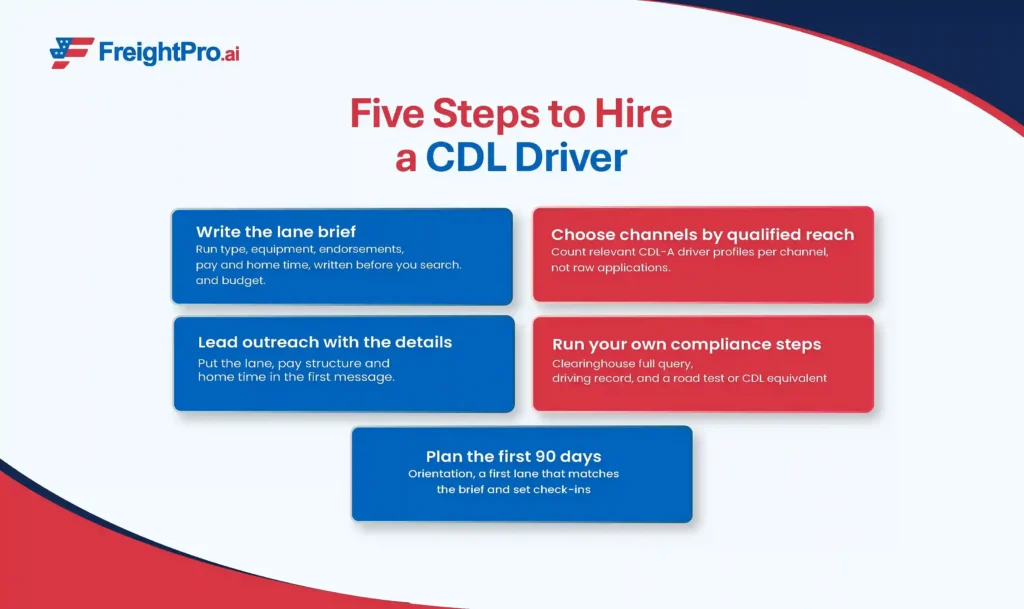
To hire a CDL driver who fits your lanes, write a lane brief, choose channels by qualified reach, lead outreach with pay and home time, run your own compliance steps, and plan the first 90 days.
Each step narrows the field toward drivers who can actually run your freight.
- Step 1: Write the lane brief before you look for drivers
Separate non-negotiables from trade-offs. Non-negotiables might be CDL-A, a Tanker endorsement, and experience on your trailer type.
Trade-offs might be the start date or the sign-on bonus structure. A vague brief is among the CDL driver hiring mistakes because it draws in profiles that cannot run the lane.
- Step 2: Choose channels by qualified reach, not application count
Pick two or three channels and measure each one against the lane brief. Carriers can find experienced CDL-A drivers through eight sourcing channels, and the sections below show how to compare them with one number. Track how many profiles meet your non-negotiables each month.
- Step 3: Start CDL driver recruitment outreach with the details drivers weigh first
Lead the first message with the lane, the pay structure, and the home time. Those are the details a driver needs to judge fit. A vague message gives the driver nothing to weigh.
Example first message, with brackets to fill in:
Hi, this is [name] at [carrier]. We run [run type] [equipment] lanes out of [terminal], with home [frequency] and pay at [pay structure]. If that fits what you want next, I can call when you are off the road.
Drivers are often on the road, so allow time for a reply and follow up once. Outreach is the first stage of how you recruit truck drivers, and screening and onboarding should repeat the same lane, pay and home-time details.
- Step 4: Run your own compliance steps before the driver operates
Compliance stays with the carrier. A sourcing channel does not complete these steps for you.
| Step | What the carrier does |
| Clearinghouse query | Run a full pre-employment query, with the driver’s electronic consent, before the driver performs safety-sensitive functions |
| Driving record and employment history | Request the state driving record covering the preceding three years and investigate safety performance history with previous DOT-regulated employers, within 30 days of the date employment begins |
| Road test | Give a road test, or accept a CDL if the issuing state requires a road test for it. Doubles/triples and tank vehicle assignments still need your own road test in a representative vehicle. |
Confirm the details with your compliance counsel or FMCSA, because requirements change.
- Step 5: Plan the first 90 days before the offer goes out
Decide the orientation schedule, the first lane, and the check-in dates before the driver accepts. Give the driver a first lane that matches the lane brief, and set check-ins at the end of week two and at 30, 60, and 90 days.
Put the pay and home-time terms from your first message in writing so nothing changes after the offer. Use each check-in to compare what the driver is living with against the lane brief.
| Check-in | What to confirm |
| End of week two | Equipment condition, dispatch communication, and how the first lane is running |
| Day 30 | Pay matches what you offered, and home time matches the brief |
| Day 60 | The lane assignment still fits, and any friction has a named fix |
| Day 90 | Review the fit together: keep the lane, adjust it, or adjust the pay structure. |
Trucking Driver Recruitment: what they do well and where qualified applications run thin
Trucking job boards put a listing in front of drivers who are already searching, which suits carriers with a clear lane and a competitive pay offer.
| What a board does well | Where a carrier often needs another channel |
| Visibility to drivers who search by job title and location | Narrow lanes, such as a regional Tanker run with weekly home time, where few searching drivers match |
| A low barrier to start | Applications arrive only from drivers who find the listing, so volume depends on search traffic for that title and area |
| A fit for common profiles with competitive pay | Applicants self-select, so you screen for equipment and endorsements yourself. |
How to judge the best job boards for truck drivers before you spend
Use a five-question scorecard to judge any board before you commit a budget. Ask each question of every board you consider, and give more spend only to the boards whose answers match your lane brief and produce qualified reach you can count.
| Question | What a useful answer looks like |
| Does it reach CDL-A drivers in my region and run type? | Audience data for your states or terminals, not only national totals |
| Do drivers see pay and home time on my listing? | Fields for pay structure and home time, shown before a driver applies |
| What screening questions can I set? | Questions for CDL class, endorsements, and equipment experience |
| How is it priced? | A clear model (flat fee, per click, or per applicant) and what you pay when applications do not fit |
| Can I track results? | Counts of applications that meet your lane brief, not only total applications |
CDL driver recruitment: compare channels by qualified reach
Qualified reach is the number of relevant CDL-A driver profiles a channel puts in front of you in a month, counted after you apply your lane brief. It turns a general feel for a channel into a number you can compare, and it shows which channels deserve more of your recruiting budget.
These four channels are the ones carriers test first:
| Channel | Where it fits | Watch for |
| Referrals from current drivers | Drivers who know your lanes and the people who run them | Reach depends on your current team’s network |
| Former drivers who left in good standing | Profiles you already know | Pay and home time may have changed since they left |
| Trucking job boards | Visibility to drivers searching for work | Use the scorecard above before you spend |
| Driver communities and social groups | Direct conversations with drivers about the lane | Needs a steady presence, and responses vary by group |
A truck that sits idle adds to the cost of an idle truck every week, so the budget belongs behind the channels that produce qualified reach.
How FreightPro helps carriers hire CDL drivers
FreightPro is a recruiting technology platform that helps carriers hire truck drivers by providing access to qualified, relevant CDL-A driver profiles. You set the criteria your lanes need, and the platform ranks profiles by AI match so you can judge fit against your lane brief.
- Filter by what the fleet needs: experience, endorsements, equipment, run type, home time, pay, and location.
- See relevant CDL-A driver profiles ranked by AI match, each with a match score percentage.
- Matching runs on 25+ AI match criteria. It is AI-powered matching, backed by our human team.
- Profiles come from 120K+ CDL-A drivers on FreightPro.
- When a profile fits your brief, unlock it to get the driver’s phone number and call. Drivers may be hauling or off duty, so plan for a callback.
- Your Clearinghouse query, driving record review, and road test stay in your own hiring process.
In qualified-reach terms, every profile you see has already been matched against the criteria you set.
Conclusion: hire the CDL driver your lane needs
Hiring a CDL driver starts with a lane brief and a measure that rewards fit. Count qualified reach for each channel, keep your compliance steps in your own process, and plan the first 90 days before the offer. If you want help setting your criteria, contact us.
Frequently asked questions
1. Can I hire a CDL-A driver with less than two years of experience?
Yes, but check your insurance first. Commercial truck insurers often set minimum experience requirements, and your policy decides whether a newer driver can run your equipment. Confirm the minimum with your insurer, then write it into your lane brief so every profile you review already meets it.
2. Why is a CDL driver not returning my call or text?
The driver is most likely on the road, hauling or resting, and cannot answer when you call. Leave a voicemail or text with the lane, pay structure, and home time, then follow up once at a different time of day. A message with those details gives the driver something to act on at the next stop.
3. Should I choose a driver based on match score alone?
No. A match score shows how closely a profile fits the criteria you set, but it does not replace your interview, road test, or required compliance steps. Use the score to decide whose profile to review first, then run the same hiring process you use for every driver.
4. How many channels should I use for truck driver recruitment at once?
Start with two or three. That is enough to compare qualified reach across channels without splitting your attention, and it lets you drop the channel with the highest cost per qualified profile. Add a new channel only after you have a month of numbers to compare it against.
5. Do I need a written lane brief if I only hire one driver?
Yes. A one-page brief keeps your outreach, your channel choices, and your interview questions tied to the same criteria. It also gives you a record of what you offered, which helps when you hire your next driver and need to compare the two searches.