
A truck driver profile is the page a carrier reads before deciding whether to call you, and a thin one gives a carrier little to match against. Carriers search on license class, endorsements, equipment, run type, pay, and home time, so a profile that leaves those out is easy to skip.
This guide shows you how to build a complete truck driver profile in eight steps, with samples for CDL-A, CDL-B, CDL-C, and owner-operator drivers. Fill in every field before you apply, and the offers you receive will fit how you actually want to drive.
| TL;DR 1. A truck driver profile gets better offers when it answers what carriers filter on: license class, endorsements, equipment, run type, pay target, and home time. 2. Build it in eight steps: license, equipment and run type, work history, summary, objective if you are new, skills, pay and home time, then regular updates. 3. Replace adjectives with numbers: years on each equipment type, miles per year, endorsements held, and the home time you need. 4. CDL-A, CDL-B, CDL-C and owner-operator drivers each need slightly different details, and a sample for each is below. |
What is a truck driver profile, and how is it different from a truck driver resume?
A truck driver profile is a structured summary of your license, endorsements, equipment, experience, pay target, and home-time needs that a carrier can read in under a minute. A truck driver resume is a document you send with an application. Most drivers benefit from having both, built from the same facts.
Carriers define the driver they want before they start looking, so each field on your profile is compared against that list. A field left blank has nothing to match.
| Truck driver resume | Truck driver profile | |
| Format | A document, usually one page | Fields and short answers in an app or online account |
| How it is read | Top to bottom by a person | Filtered by field, then read |
| Best at | Telling your work story | Showing license, endorsements, equipment, pay, and home time at a glance |
| When you update it | When you apply | Whenever something about your driving changes |
| Where you use it | Applications, emails, recruiter requests | Job matching and carrier searches |
Build the profile first. Your resume then becomes a printout of facts you have already organized.
How to write a truck driver resume and profile in 8 steps
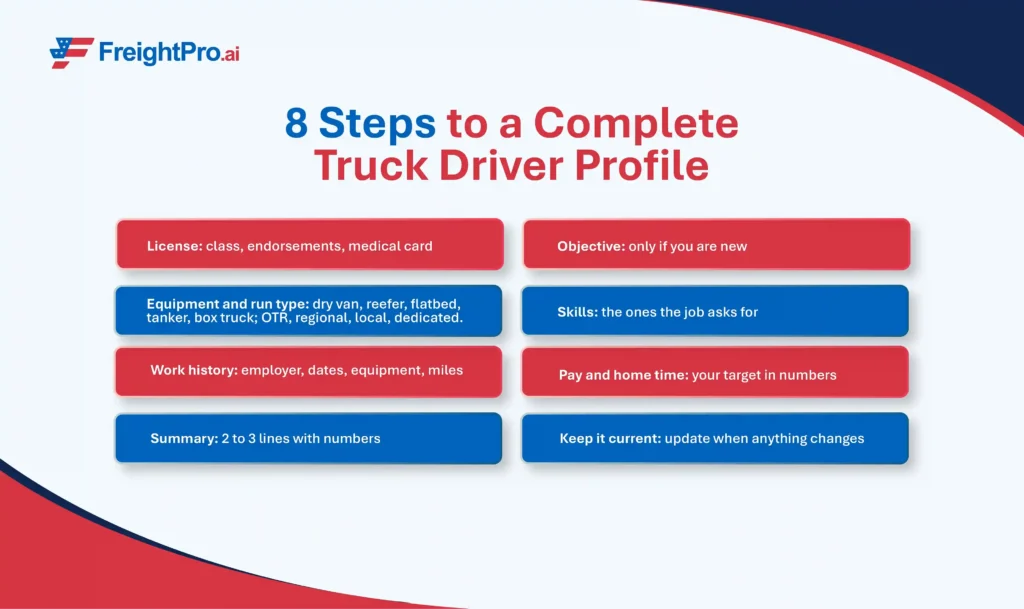
Work through eight steps in order: license and endorsements, equipment and run type, work history, summary, objective, skills, pay and home time, and updates. Each step adds one field carriers look for, and the same facts fill both your profile and your resume.
- License class, endorsements, and medical card
- Equipment and run type
- Work history in miles and results
- A short summary
- An objective, if you are new to the road
- Skills that match the job
- Pay target and home time
- Contact details, video introduction, and regular updates
Step 1: Start your CDL A driver resume with class, endorsements, and medical card
Put your license class, endorsements, and medical card status at the very top, because they decide which jobs you can take. Write CDL-A, CDL-B, or CDL-C, then list each endorsement by letter and name.
| Code | Endorsement | What it covers |
| H | Hazardous materials | Hauling placarded hazmat loads |
| N | Tank vehicles | Liquid or gas tankers |
| T | Doubles/triples | Pulling more than one trailer |
| P | Passenger | Carrying passengers |
| S | School bus | Driving a school bus |
| X | Tank and hazmat combined | Tankers hauling hazmat |
Add your medical card expiration date and any other credential you hold, such as a TWIC card. An expired card on your profile reads as a risk, so keep these dates current.
Writing a CDL driver resume for Class B and Class C.
Class B covers single heavy vehicles such as straight trucks, box trucks, dump trucks, and buses, so name the vehicle you drive, the dock work you handle, and the daily home time you want. Class C covers vehicles that carry 16 or more passengers or hazardous materials, so lead with your P, S, or H endorsement and the kind of route you have run. Class A drivers name the trailer types instead.
Step 2: Show the equipment you have driven and the run you prefer
List each equipment type with the years or months you have run it, then name the run type you want next: OTR, regional, local, or dedicated. Carriers look for experience close to their own freight.
- Equipment: dry van, reefer, flatbed, tanker, box truck, dump truck, with years on each.
- Run type: OTR, regional, local, or dedicated, plus the states or region you know.
- Truck details if they matter: automatic or manual transmission, sleeper, APU.
Some carriers can only hire drivers with two years of experience because of their insurer’s rules, so state your tractor-trailer time in years and months. Years on one equipment type do not automatically cover another, so say plainly what you have and have not run.
Step 3: Write your work history in miles, equipment, and results
For each job, list the employer, city and state, dates, equipment, run type, and one measurable result. Numbers show carriers what you actually did, and adjectives do not.
| Field | Example (illustrative, use your own figures) |
| Employer | Example: Carrier Inc., Memphis, TN |
| Dates | March 2022 to present |
| Equipment and run | 53-foot reefer, regional Southeast |
| Miles | About 110,000 miles a year |
| Result | No preventable accidents in 4 years |
Good results to include are miles per year, on-time delivery, a clean inspection record, and any time spent as a trainer. List only results you can back up with a record or a reference, and explain any gap in your dates with one short, true line.
Step 4: Write a summary, with truck driver resume summary examples
Write a summary of two or three lines that names your class, years of experience, equipment, endorsements, and the job you want next. Here are three truck driver resume summary examples to adapt.
- CDL-A, OTR dry van: CDL-A driver with 6 years of OTR dry van experience, Hazmat and Tanker endorsements, and 600,000 safe miles. Looking for a dedicated lane with weekly home time.
- CDL-B, local: CDL-B driver with 3 years of local box truck and dump truck experience, comfortable with liftgates and tight urban docks. Seeking steady local routes with daily home time.
- CDL-C, passenger: CDL-C driver with a Passenger endorsement and 2 years of shuttle experience on set routes. Looking for a full-time route with a consistent schedule.
Step 5: Add an objective if you are new, with truck driver resume objective examples
An objective fits a driver who is new to the road, returning after a break, or moving to a different run type. Experienced drivers should use a summary instead. Two truck driver resume objective examples:
- Newly licensed CDL-A driver who completed CDL training, seeking a company that provides a trainer and a path to regional routes.
- CDL-A driver returning to the road after two years off, with 5 prior years of regional reefer experience, seeking a regional lane with weekly home time.
Step 6: List truck driver resume skills that match the job
List only the skills you can use on day one, and put the ones the job asks for first. Group them so a carrier can scan them.
| Group | Examples |
| Equipment handling | Pre-trip inspection, backing and docking, tarping and load securement, reefer temperature monitoring, tanker handling |
| Compliance and safety | Hours-of-service compliance, DOT roadside inspections, defensive driving, hazmat procedures if you hold the H endorsement |
| Technology | ELD use, truck-focused navigation and trip planning, mobile dispatch and paperwork apps |
| Communication | Updating dispatch on delays, customer dock etiquette, clear load documentation |
Step 7: State your pay target and home time
Write the pay structure you want, in cents per mile, hourly or weekly, and the home time you need, in the same terms carriers use. A clear target keeps your profile matched to offers you would actually accept.
Carriers attract qualified truck drivers with pay, benefits, and home time, so decide your own numbers before you compare theirs.
- Pay: your minimum cents per mile or weekly figure, and any must-haves such as detention or layover pay.
- Home time: home daily, every weekend, or every two weeks, written the way you need it.
- Other: benefits start date, assigned truck, sign-on bonus terms.
Be honest with yourself here. A number you would not accept wastes your time and the carrier’s.
Step 8: Add contact details, a video introduction, and keep it current
Add a phone number, an email, and a best time to call, because carriers may reach you while you are driving or resting. If the platform offers a video introduction, record about 30 seconds covering your class, equipment, and the work you want next. Update the profile whenever an endorsement, truck, or home-time need changes.
Truck driver resume examples: a sample profile you can copy
A strong sample profile fits on one screen: license class, endorsements, equipment, run type, work history, skills and preferences, each with specific numbers. Use this regional reefer example as a pattern for your own, and replace every figure with your own details.
| Field | Sample (illustrative only) |
| License | CDL-A, Tanker (N) and Doubles/Triples (T) endorsements, medical card valid through June 2027 |
| Experience | 4 years tractor-trailer, all regional |
| Equipment | 53-foot reefer (3 years), dry van (1 year) |
| Run type | Regional, Southeast |
| Miles | About 110,000 a year |
| Safety | No preventable accidents in 4 years |
| Summary | CDL-A driver with 4 years of regional reefer experience and Tanker and Doubles/Triples endorsements. Looking for a regional lane with weekends at home. |
| Pay target | 80+ cents per mile |
| Home time | Home every weekend |
| Best time to call | Weekdays after 6 p.m. |
For a Class B version, replace the equipment and run type with your vehicle and routes: for example, local box truck, 3 years, daily home time, liftgate and urban dock experience.
Truck driver resume template: copy, paste, and fill in
Copy this truck driver resume template into a one-page document and replace each bracket with your own details. Keep a short version in your phone notes so you can paste it into an application, and use the same wording on your profile.
| Section | What to write |
| Name and contact | [Full name] | [Phone] | [Email] | [City, State] | Best time to call: [time] |
| License | [CDL class] | Endorsements: [letters and names] | Medical card valid through [date] |
| Summary or objective | [2 to 3 lines: class, years, equipment, endorsements, the job you want next] |
| Equipment and run type | [Equipment type and years] | [OTR, regional, local or dedicated] | [States or region] |
| Work history | [Employer, city, state] | [Dates] | [Equipment, run, miles per year] | [One measurable result] |
| Skills | [Equipment handling] | [Compliance and safety] | [Technology] | [Communication] |
| Preferences | Pay: [target] | Home time: [needed] | Other: [benefits, assigned truck] |
Owner operator resume example: what to change when you run your own truck
An owner-operator profile adds the business details a company driver does not carry: your authority, your equipment, your insurance, and the lease terms you want. It reads as a small business, so present it like one.
Here is an owner-operator resume example to adapt.
- Authority: Your MC and DOT numbers and the year your authority became active.
- Equipment: Year, make, and model of your tractor, trailer type, ELD, and APU.
- Insurance: The coverage you carry, in the limits you actually hold.
- Lanes and freight: The freight you haul, the regions you run, and the customers you can name.
- Record: Miles per year and any inspection or on-time results you can back up.
- What you want: Lease-on terms, dedicated freight or direct customer work, with the settlement terms you will accept.
Sample summary: Owner-operator with 5 years running my own authority, 2021 tractor with 53-foot dry van, and 550,000 miles with no preventable accidents. Looking for a dedicated lane with a fair settlement and steady weekly miles.
What mistakes keep a truck driver profile from getting noticed?
The most common mistakes are missing endorsements, no equipment type, vague adjectives, and out-of-date information. Each one removes a field carrier’s search or makes the rest of the profile harder to trust. Check your profile against this list before you apply.
- Writing “hard worker” instead of miles, years, and results.
- Leaving out endorsements you hold or listing ones that have lapsed.
- Hiding your pay target and home-time needs, then turning down offers that miss them.
- Listing every skill you have ever used instead of the ones the job asks for.
- Letting dates, trucks, and phone numbers go out of date.
How does a FreightPro driver profile put these steps to work?
The fields above are the same ones in a FreightPro driver profile. FreightPro is a trucking ecosystem for CDL drivers across Class A, Class B, and Class C, built around jobs and the tools you use on the road.
- Your profile shows carriers your experience, endorsements, equipment, run type, and pay and home-time expectations.
- The app matches you to jobs with a fit score and shows pay and benefits up front.
- Local, regional, and OTR jobs are listed in the same place, and you can add a video introduction.
- Between jobs, the same app has truck-focused navigation, truck stops, weigh station status, and parking reports from other drivers.
Carriers can see your profile when they search, so a complete one gives them what they need to judge the fit. Whether a carrier reaches out depends on how well your profile fits what they need.
Your next step: build the profile before you need the next job
Start with the template above and fill in one step at a time, beginning with your license and endorsements. A profile built from numbers, equipment, and clear preferences gives carriers what they need to decide whether you fit.
Carriers still compete for qualified drivers, so the details you add are what set your profile apart.
If you have a question about your profile, you can contact the FreightPro team.

Frequently asked questions
1. How long should a truck driver resume be?
One page is enough for most drivers. Carriers read a truck driver resume for license class, endorsements, equipment, and recent work, so keep those at the top and trim anything older than your last ten years of driving unless it shows equipment experience you still want to use.
2. Can I get a CDL job with no experience?
Yes, some carriers hire new CDL holders and provide a trainer, while others require one or two years of experience, often because of insurer rules. Put your training school, license class, and endorsements first, and say which training or mentor program you are looking for.
3. Should I list my MVR or accident history on my resume?
No. Carriers obtain your motor vehicle record themselves during hiring, so you do not need to paste it. Do list safety results you can back up, such as years without a preventable accident, and be ready to explain any violation honestly when asked.
4. What should I put on my profile if I am switching from local to OTR driving?
Lead with what carries over: your license class, endorsements, safety record, and any tractor-trailer time. Then state the OTR run you want in your summary or objective. Be clear about the home time you can accept, since time away from home is a major change.
5. Can I use one resume for local CDL-B jobs and OTR CDL-A jobs?
You can keep one set of facts, but change the summary, the equipment you list first, and the home time you ask for. A local box truck job cares about daily routes and dock work, while an OTR job weighs miles, endorsements, and time away from home.