“CDL-A Drivers Needed. Great pay. Great home time. Apply now.”
That ad could belong to any carrier in the country, which is exactly the problem. Read it the way a driver does, standing at a fuel island with a phone in one hand, comparing it against other ads.
- Great pay compared to what?
- Home every week or every three weeks?
- Dry van, reefer, or flatbed?
For a small fleet, the stakes are higher than they look. Applications are limited to begin with, and only some of the ones that arrive fit your lanes, equipment, and home-time setup. Before you post truck driver jobs, the ad itself has to do the sorting.
This guide shows how to write a CDL job ad that gives a driver enough facts to decide. You get a checklist of what a CDL job description should include, a copy-ready template, a do and don’t list, and a way to cover the other half of the work.
| TL;DR 1. A CDL job ad works when a driver can tell within seconds whether the run fits: the pay structure, home time, lanes, equipment, and requirements. 2. Plain, specific details let qualified drivers recognize the fit and let others pass without a wasted conversation. 3. Use one template, keep the facts identical wherever the ad runs, and leave out any claim you cannot support. 4. The ad is half of the work. Searching for relevant CDL-A driver profiles on FreightPro covers the other half. |
What makes a CDL job ad attract qualified applicants?
A CDL job ad attracts qualified applicants when it answers the questions a driver asks before applying: what the run is, how the pay works, when they get home, and what they will drive. Specific, honest details let the right drivers recognize the fit and let the wrong fits pass without spending your time.
Drivers compare ads side by side. A vague ad gives them nothing to compare, so it loses to an ad that names the pay structure and the home-time pattern. A driver who needs to be home weekly can rule out a two-week run from the ad alone, and that saves you both a phone call.
When applications are limited, every conversation counts. Each one spent on a mismatch is one you do not get back, so the ad should do as much of the qualifying as it honestly can.
What should a CDL job description include?
A CDL job description is the written summary of a driver role: the run, the equipment, the pay, the requirements, and how to apply. Inside an ad, it is the part a driver reads to decide whether to keep reading.
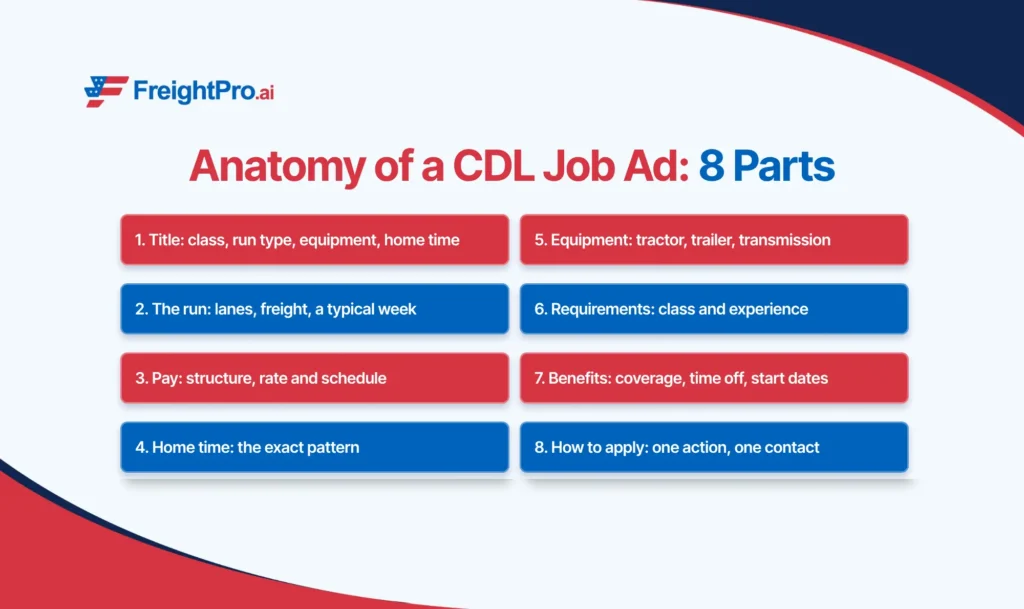
These eight elements cover what drivers look for.
| Element | What to write | Why drivers look for it |
| Job title | CDL class, run type, equipment, and home time, such as “Regional CDL-A Driver, Dry Van, Home Weekly” | Shows the fit before the ad is even opened |
| Pay | The pay structure (per mile, hourly, or weekly), the rate or range, the pay schedule, and any sign-on terms exactly as paid | Pay is the first comparison a driver makes |
| Home time | The exact pattern, such as home weekly or home every other weekend | Often decides between two similar offers |
| Lanes and freight | Regions, typical runs, freight type, and whether freight is touch or no-touch | Describes what a normal week looks like |
| Equipment | Tractor and trailer type, transmission, whether the truck is assigned or shared | Drivers want to know what they will operate |
| Requirements | CDL class, endorsements, minimum experience, medical card, and the DOT hiring steps you follow | Lets qualified drivers proceed, and others pass |
| Benefits | Coverage, paid time off, and when each benefit begins | Completes the picture of the full package |
| How to apply | One clear action and who responds | Removes guesswork about the next step |
Pay deserves the most care
Give the number. If the rate depends on conditions, such as mileage tiers or tenure, say so in the ad. A driver who discovers the conditions later will feel misled, and that impression is hard to repair.
How do you write the job title and opening lines of a CDL ad?
Lead with the details a driver filters on: CDL class, run type, equipment, and home time.
A title such as “Regional CDL-A Driver, Dry Van, Home Weekly” tells a driver what the run is before they open the ad. Save the company story for later in the ad.
Open the body with the run itself: the lanes, the freight, and what a typical week looks like. Then give pay, then requirements. Many drivers read on a phone, so keep paragraphs short and put pay and home time on the first screen.
The table below shows how to turn common vague lines into specific ones. Replace each bracket with a fact you can stand behind.
| Vague line | Specific line |
| “Great pay” | [Rate] per mile, paid weekly, with sign-on terms listed below |
| “Great home time” | Home every weekend, with the pattern stated in plain words |
| “Newer equipment” | [Year range] [make] tractors with [automatic or manual] transmission, [assigned or shared] |
| “Experienced drivers only” | At least [number] months of recent CDL-A driving experience, [equipment type] preferred |
| “Great benefits” | [Medical, dental and vision] starting [timing], plus paid time off |
What does a CDL job ad template look like?
A good template is a fixed set of sections with a bracket for every fact. Copy the version below, replace each bracket, and delete anything that does not apply to the run. Write a separate ad for each run type or equipment type.
| CDL JOB AD TEMPLATE [Job title] Regional CDL-A Driver | Dry Van | Home [Weekly or Every Other Weekend] About the run [Company name] is hiring CDL-A drivers for [regions or lanes]. You will haul [freight type] in a [dry van, reefer, or flatbed]. Freight is [touch or no-touch]. Pay [Pay structure]: [rate or range]. Paid [pay schedule]. [Sign-on or bonus terms, exactly as paid.] Home time [Exact home-time pattern.] Equipment [Year range and make] tractors, [automatic or manual]. [Assigned to you or shared.] Requirements • Valid CDL-A • [Endorsements, if required] • At least [number] months of recent CDL-A experience • Valid DOT medical card • Willingness to complete our DOT hiring steps, including drug testing and a Clearinghouse query Benefits [Coverage, paid time off and other benefits, and when each begins.] How to apply [One action: phone number, link or form.] [Name or team that responds.] [Hours you take calls.] Closing line [Equal opportunity employer statement.] |
If a bracket has no answer yet, settle it inside your company before the ad goes live. An ad that is vague because the details are undecided will read as vague to drivers too.
What are the do’s and don’ts of a CDL job ad?
Do state facts a driver can compare, and do not hide or inflate them. Most weak CDL ads fail in the same places: missing pay detail, unstated home time, and claims that cannot be backed up.
The list below covers the most common ones.
| Do | Don’t |
| State the pay structure and the rate or range | Write “great pay” or “top pay” with no number |
| Name the home-time pattern exactly | Promise “home time” without saying what it means |
| List requirements plainly: class, endorsements, experience | Hold requirements back until the phone call |
| Describe the equipment and lane most drivers will actually get | Describe the best truck in the fleet if most drivers will not drive it |
| Keep the same facts everywhere the ad runs | Change pay or terms from one site to the next |
| Write in plain language, in short paragraphs | Open with a long company history or heavy jargon |
| Include an equal opportunity statement | Use wording that signals a preference for age, sex, or other protected traits |
| Use only claims you can support | Claim “#1,” “best” or guaranteed outcomes |
Where to Find Truck Driver Job Posting Sites for Your CDL Hiring
Post truck driver jobs where CDL drivers already look: your own careers page, general job sites, trucking-focused job sites, driver communities, and referrals from current drivers.
No single place suits every carrier, so match each channel to the run you are advertising and keep the facts identical across all of them.
| Channel type | Works well for | What to check |
| Your careers page | Every run, with the full details | Easy to find from your website and readable on a phone |
| General job sites | Local and regional runs near a city | Whether the listing format lets you show pay structure and home time |
| Trucking-focused job sites | Reaching drivers already searching for CDL work | Cost, how listings display and whether you can edit details |
| Driver communities and social groups | Getting your company name in front of drivers | The group’s rules on recruiting posts |
| Referrals from current drivers | Runs where fit matters most | Referral terms written down: amount, timing and conditions |
| Platforms with searchable driver profiles | Reaching relevant profiles directly, alongside incoming applications | Whether the filters match what your run needs |
Whichever channels you pick, check each live listing after it goes up. Confirm that pay, home time, and requirements display the way you wrote them, because some formats trim or reorder fields.
How do you know whether your CDL job ad is working?
Review the ad by looking at who responds and what they ask. If the same question keeps coming up, such as how pay is calculated or how often drivers are home, that detail is missing or buried.
If applicants regularly miss a stated requirement, move the requirement higher in the ad.
- Keep a short list of the questions drivers ask on first calls, and add the answers to the ad.
- Change one element at a time, such as the title or the pay line, so you can tell what made the difference.
A small fleet will not have much data, so treat each change as a test, not a verdict. Read the ad again as a driver would after every edit, and remove anything you would not want to explain on a call.
How can FreightPro help you reach relevant CDL-A driver profiles?
FreightPro lets carriers search for qualified, relevant CDL-A driver profiles instead of relying only on incoming applications. You filter by what the run needs, and AI-powered matching, backed by our human team, ranks profiles against those filters with a match score.
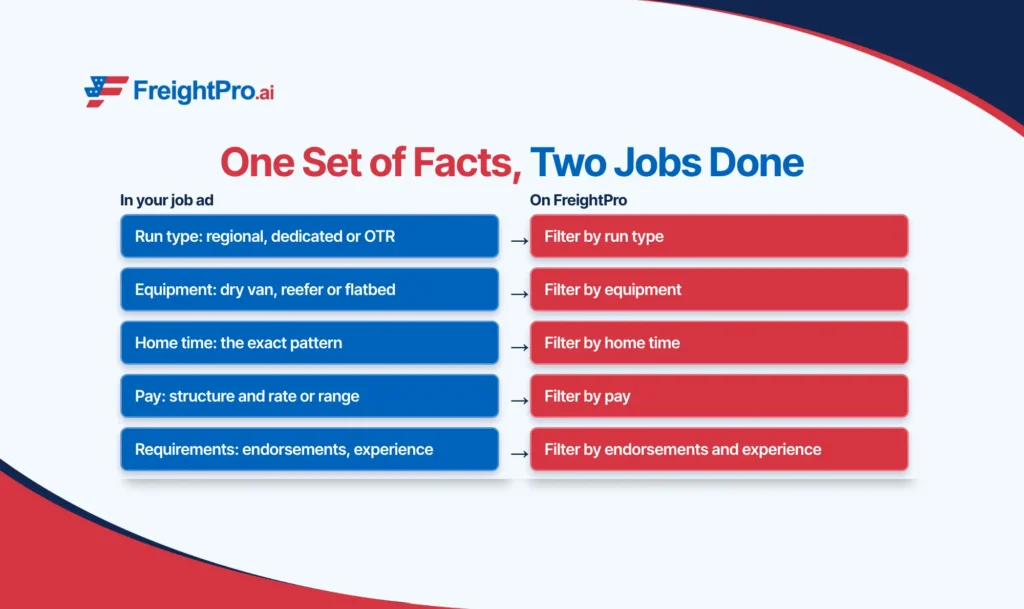
That is why the ad details matter twice. The facts you wrote for the ad, such as run type, equipment and home time, are the same facts you use to search. Here is how it works on FreightPro.
- Sign up and filter by what your fleet needs. Choose experience, endorsements, equipment, run type, home time, pay, and location.
- Review relevant CDL-A driver profiles ranked by AI match. Each profile shows a match score, and FreightPro uses 25+ AI match criteria.
- Contact the drivers who fit. When a profile looks right, unlock it to get the driver’s phone number and call. Drivers may be on the road or hauling, so a call may not connect on the first try.
FreightPro helps you find relevant profiles. Your own qualification steps, such as MVR review, Clearinghouse queries, and your driver qualification file, stay with you.
Frequently asked questions
1. How long should my truck driver job ad be?
Short enough to read on a phone in a minute or two, and long enough to cover the run, pay, home time, equipment, requirements, and how to apply. For most runs, that means a few short sections rather than a long company story. Put pay and home time near the top.
2. Can I list a pay range instead of one rate in my CDL job ad?
Yes. A range works when you explain what moves a driver within it, such as experience, lane, or tenure, and state how pay is calculated and when it is paid. Some states require pay information in job postings, so check the rules where you recruit.
3. Can I say “experienced drivers only” in my CDL job ad?
You can, but define it. State a minimum, such as months of recent CDL-A driving experience, and the equipment type that experience should cover. “Experienced” means different things to different drivers, so a clear minimum helps the right applicants recognize themselves.
4. Should I mention a sign-on bonus in my truck driver job ad?
Yes, if you pay one, and spell out the terms: the amount, when it is paid, and any conditions, such as time with the company. Drivers read bonus language closely, and vague wording invites doubt about what the offer really is.
5. Can I use one job ad for dry van, reefer and flatbed runs?
No. Write a separate ad for each run, because equipment, freight, lanes, and home time differ, and drivers search by equipment. A shared base template saves effort, but changes the title, equipment, pay, and home-time details for each ad so every driver sees the facts that apply to that run.
6. What can I do if my CDL job ad gets few applications?
Review the ad for missing details first, then widen where you look. On FreightPro, you can search for relevant CDL-A driver profiles by experience, endorsements, equipment, run type, and home time, so your ad and your search work from the same facts.