
| TL;DR 1. To recruit truck drivers in 2027, follow 8 steps: define the driver, build a comparable offer, source from 2 or 3 channels, contact drivers the same day, screen to FMCSA rules, interview for fit, make the offer, and onboard for 90 days. 2. Most qualified drivers already have a job. They choose their next carrier on lanes, pay, and home time, so recruit for fit, not applicant volume. 3. Check CDL type and English proficiency on the first call, since both decide whether you can legally put the driver in a truck. 4. Judge recruiting by time-to-hire and 90-day retention. |
Picture a Friday afternoon at a 40-truck reefer fleet in Joplin, Missouri. The owner works through a call sheet of 31 applicants between dispatch calls and four pickups. The strongest, with 18 months of verifiable reefer experience and a clean MVR, wants to be home every weekend. The lane on offer keeps a driver out two weeks at a time.
By Monday, two trucks are still parked with no driver assigned. The owner’s instinct is to raise the sign-on bonus and run more ads. But a bigger bonus does not change a lane that keeps drivers out for two weeks, and it brings in more callers who were never a match. This guide shows what to do instead.
Getting this right matters more every year. Running a truck cost a record $2.336 per mile in 2025, per ATRI’s 2026 cost report, so every week a truck sits without a driver is harder to absorb.
Truck driver recruiting is the process a carrier uses to find, qualify, and hire CDL drivers who fit its freight, lanes, and safety standards, and then keep them on the road past the first few months.
This guide is written for owners, safety managers, and recruiters at fleets of roughly 10 to 150 trucks, where recruiting is one person’s job or part of the owner’s week. You will get an eight-step process with examples, the FMCSA checks every hire needs, and the numbers that show whether it is working.
What makes recruiting truck drivers harder in 2027?
Recruiting is harder in 2027 because most qualified drivers already have a job, an idle truck costs more to absorb, and fewer drivers are eligible after the 2026 non-domiciled CDL rule and English proficiency enforcement. Each one changes how you run the steps below:
• Most qualified drivers already have a job. Large truckload carriers averaged 92.7% yearly driver turnover from 1996 to early 2023, and smaller fleets averaged 77.6%, per ATA data (FreightWaves). The drivers you reach are weighing a switch and comparing lanes, home time, and pay line by line.
• Every idle week costs more. Running a truck cost a record $2.336 per mile in 2025 (ATRI), while dry van contract linehaul margins over non-fuel costs fell from about $1.01 to $0.26 per loaded mile between 2022 and 2025 (FreightWaves).
• Fewer drivers are eligible. Since March 16, 2026, new and renewed non-domiciled CDLs are limited to H-2A, H-2B, or E-2 status (Jackson Lewis), and failing English proficiency is an out-of-service violation under CVSA criteria (DISA), which FMCSA proposed in August 2026 to write into federal rules (Federal Register). Step 5 moves
both checks to the first call.
Recruit for fit, not volume
When recruiting truck drivers, small fleets should focus on finding the right candidates instead of chasing applicant volume. More ads and bigger sign-on bonuses can bring in more applicants who aren’t a good match. A solo recruiter can quickly run out of time before finding qualified drivers.
Focus on these three priorities:
- Define a precise driver profile: Identify the lanes, equipment experience, endorsements, home-time expectations, and pay requirements that matter for the role. This helps you recruit CDL drivers who are more likely to fit the job.
- Be honest about the offer: Clearly explain pay, schedules, routes, and home time so drivers know what to expect before applying.
- Contact qualified drivers the same day: Respond quickly to suitable candidates instead of spending time processing mismatched applications. A clear, responsive process makes it easier to hire truck drivers who meet your requirements.
Fit-first recruiting can make certain roles harder to fill, particularly those involving tanker, team, or hazmat runs. For these positions, consider widening your hiring radius or hiring candidates who can learn specific skills, provided they meet the requirements set by your insurer and the freight. A focused CDL driver recruitment strategy helps balance hiring speed with job fit.
How to recruit truck drivers in 8 steps
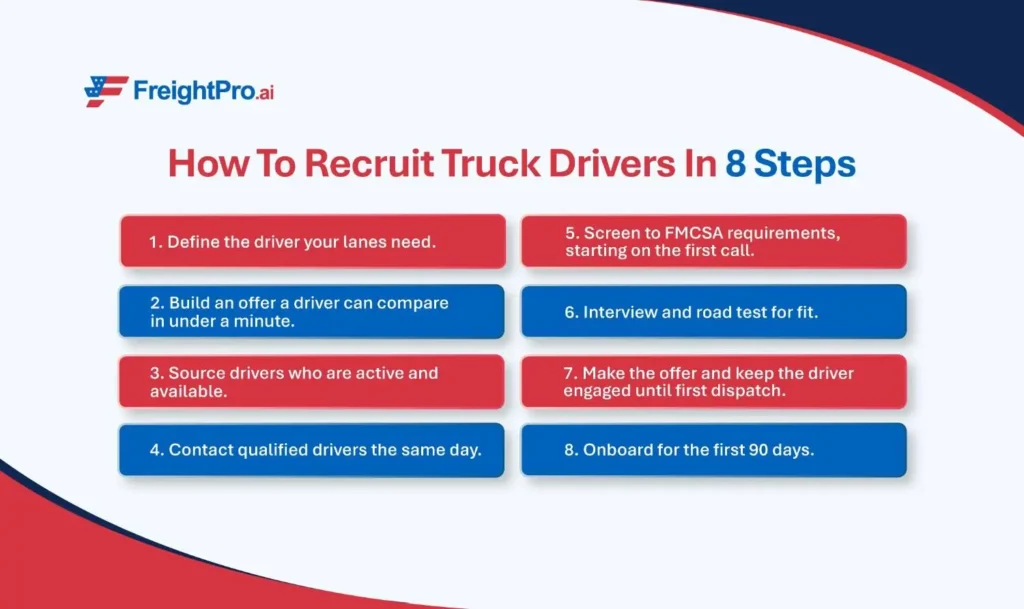
Recruit truck drivers by working through eight steps in order. Each one removes a common reason a hire falls through or leaves early.
- Define the driver your lanes need.
- Build an offer a driver can compare in under a minute.
- Source drivers who are active and available.
- Contact qualified drivers the same day.
- Screen to FMCSA requirements, starting on the first call.
- Interview and road test for fit.
- Make the offer and keep the driver engaged until first dispatch.
- Onboard for the first 90 days.
Step 1: Define the driver your lanes need
Write a driver profile from your freight before you spend anything on sourcing. List the run type, equipment, endorsements, experience, safety record, home time, pay, and hiring radius the lane requires. If you run three lane types, write three profiles, not one blended ad.
| Criteria | Question to answer | Example |
|---|---|---|
| Run type | OTR, regional, local, or dedicated? | Regional, Southeast, 5 to 6 days out |
| Equipment | Dry van, reefer, flatbed, tanker? | 53-foot reefer |
| Endorsements | Hazmat (H), Tanker (N), Doubles/Triples (T), X? | None required; tanker a plus |
| Experience | Minimum verifiable months, and in what equipment? | 12 months verifiable Class A |
| Safety record | What MVR and crash history will your insurer accept? | No major violations in 3 years |
| Home time | What can the lane deliver every week, honestly? | 34-hour reset at home weekly |
| Pay | CPM, weekly average, accessorials? | CPM range plus detention and stop pay |
| Location | How far from the terminal can the driver live? | Within 150 miles of the terminal |
Then sort each line into must-have or trainable. Your insurance policy usually sets the must-haves, so check your underwriter’s minimum experience and MVR rules first. Anything beyond that narrows the drivers you can reach without making the hire safer.
- Must-have (regional reefer example): Class A CDL, 12 months verifiable tractor-trailer experience, no major violations in 3 years, lives within 150 miles of the terminal.
- Trainable: reefer temperature management, your customers’ appointment rules, and your ELD and dispatch tools.
A tight profile narrows the drivers you can reach, especially on tanker, team, or hazmat runs. On those lanes, widen your hiring radius or move skills like tanker handling into the trainable column, as long as your insurer and the freight allow it.
Keep this profile for sourcing. On logistics recruitment platforms such as FreightPro, the same criteria serve as search filters, turning a written profile into a ranked list of drivers who match the lane.
Step 2: Build an offer a driver can compare in under a minute
Experienced drivers compare offers side by side, so make pay, home time, equipment, and benefits plain enough to compare in under a minute. Vague pay ranges and “great home time” read as something to hide. Specific numbers earn the callback, even when they are not the highest.
- Pay structure: CPM or percentage, the realistic weekly average for the lane, and whether miles are paid practical or HHG.
- Accessorial pay: detention, layover, stop pay, and breakdown pay, with the thresholds.
- Home time: how often, for how long, and where, written the way dispatch will actually deliver it.
- Equipment: truck age, transmission, inverter or APU, and whether trucks are assigned or slip-seated.
- Benefits and bonuses: when health coverage starts, paid time off, and when any sign-on bonus pays out.
Build the weekly pay figure from real settlements. Take the last 8 to 12 weeks of settlements for drivers already on that lane and quote the typical range, not the best week. When the first paychecks match what you quoted, you remove an early reason for a new driver to leave.
Example offer (illustrative): Regional reefer, Southeast. Out 5 to 6 days, home every weekend for a 34-hour reset. Paid per practical mile, detention after 2 hours. Weekly average from last quarter’s settlements: [your range]. Assigned tractor with APU. Health coverage from day 30.
For a benchmark, ATRI found driver wages averaged 81.8 cents per mile in 2025, plus about 21 cents per mile in benefits. If your lane pays below that, lead with what you do better, such as assigned trucks, steady freight from a dedicated customer, or more predictable home time.
Step 3: Source drivers who are active and available
Source from two or three channels that reach drivers who are open to a move now, rather than spreading a small budget across everything. Start with the low-cost channels you already know, then add paid channels to cover the gap.
| Channel | Best for | First move |
|---|---|---|
| Employee referrals | Drivers who fit your culture and tend to stay | Pay the referral bonus in two parts, with the larger part after day 90 |
| Former drivers (rehires) | Fast ramp-up on known lanes and equipment | Call drivers who left in good standing in the last two years and tell them what changed |
| CDL schools | Entry-level drivers and long-term growth | Confirm your insurer accepts new CDL holders before building a school relationship |
| Military transition programs | Disciplined drivers, some with CMV experience | Plan outreach around separation dates |
| Recruiting platforms that match on criteria, such as FreightPro | Experienced CDL-A drivers filtered to your profile | Filter by your Step 1 profile and check how current the profiles are |
| Driver communities and social | Reaching drivers when they are off duty | Share real lane details and photos of your actual equipment; expect a slow build |
| Owner-operator lease-on | Adding capacity without buying trucks | Put lease terms and settlement details in writing up front |
Referrals and rehires are underused at small fleets because they feel slow, yet they come pre-screened for fit by people who know your operation. Record the channel for every hire, and after two or three months, shift effort toward the channels whose hires are still driving at day 90.
Use a credible truck driver recruitment platform
A recruiting platform earns a place in your channel mix when it cuts the calls you spend on drivers who don’t fit.
FreightPro is America’s leading recruiting platform for CDL-A drivers. You filter by the criteria your lanes need, see active and available drivers ranked by AI match score, unlock a driver’s profile to get their number, and call them directly. Its AI-powered matching, backed by our human team, uses 25+ AI match criteria.
Driver validation is where the human team comes in. 93% of driver profiles on FreightPro are personally vetted by our team, which works on keeping driver availability and activity current. Some drivers will still be on a load when you call, so leave a short text or voicemail with the lane, pay, and home time.
Step 4: Contact qualified drivers the same day
Contact a qualified driver the same day you find them, and cover lane, pay, and home time in the first minute. Good drivers talk to several carriers in a week. Speed is an advantage a small fleet can hold over a large one.
Drivers are often behind the wheel when you call. Text first, then call in the evening or at a likely break, and leave a voicemail that gives a reason to call back. If you found the driver on FreightPro, the unlocked profile gives you their number, so that first text can go out the same day.
Example first text: “Hi Marcus, this is Dana at [fleet name]. Regional reefer, Southeast, home every weekend, paid practical miles. You run reefer, so I think it fits. Good time to talk tonight?”
- Open with the match: “You run reefer in the Southeast and want weekly home time. That is the lane I have.”
- Give the numbers early: pay structure, weekly average, and home time before any screening questions.
- Ask what would make them move: pay, home time, equipment, or how dispatch treats them.
- Confirm basics: CDL class, type and expiration, endorsements, experience with the equipment, and recent violations.
- Set the next step before you hang up: application link, a call with dispatch, or a road test date.
Step 5: Screen to FMCSA requirements, starting on the first call
Before a new driver operates a commercial motor vehicle, 49 CFR Parts 382 and 391 require an application, motor vehicle records, previous-employer safety history, a pre-employment Clearinghouse query, a negative drug test, a medical certificate, and a road test or accepted equivalent.
A personally vetted profile on FreightPro helps you start with drivers who fit, and you can talk to the FreightPro team about how the vetting works, but these checks stay with your safety team.
- CDL type and expiration. Ask whether the license is a standard or non-domiciled CDL and when it expires. A non-domiciled CDL issued or renewed since March 16, 2026 must be tied to H-2A, H-2B, or E-2 status.
- English proficiency. The driver must read and speak English well enough to talk with officials, read road signs, and fill out reports. Judge it during the call itself, the way a roadside inspector would.
| Check | Rule | What it covers |
|---|---|---|
| Employment application | 49 CFR 391.21 | Employers for the past 3 years; CDL applicants also list CMV employers for the 7 years before that |
| Motor vehicle record (MVR) | 49 CFR 391.23(a)(1) | Record from each state where the driver held a license in the past 3 years, obtained within 30 days of hire |
| Previous-employer safety history | 49 CFR 391.23(a)(2), (d) | DOT-regulated employers from the past 3 years, including DOT-recordable crashes |
| Clearinghouse pre-employment query | 49 CFR 382.701(a); 391.23(e)(4) | Drug and alcohol program violations; needs the driver’s specific consent |
| Pre-employment drug test | 49 CFR 382.301 | Verified negative result before any safety-sensitive work |
| Medical examiner’s certificate | 49 CFR 391.41, 391.43 | Physical qualification to drive a CMV |
| Road test or equivalent | 49 CFR 391.31, 391.33 | Ability to operate the equipment |
| English language proficiency | 49 CFR 391.11(b)(2) | English good enough for road signs, officials, and reports |
| CDL class, endorsements, type | 49 CFR Part 383 | Correct class and endorsements; non-domiciled eligibility and expiration |
| PSP report (recommended) | FMCSA PSP program | 5 years of crash data and 3 years of roadside inspections, with driver consent |
Run the checks in parallel. Request the MVR, previous-employer history, and Clearinghouse consent the day the application arrives, and book the drug test and road test together. A process that runs one check after another adds days that a driver with other offers will not wait.
Every document goes into the driver qualification (DQ) file required by 49 CFR 391.51 (eCFR, Part 391). This is a plain-English summary, not legal advice, so confirm your process with compliance counsel or FMCSA.
Step 6: Interview and road test for fit
A driver who passes every check can still leave in a month if the job does not fit how they want to drive. Use the interview to test fit on home time, lanes, equipment, and dispatch style.
- Why are you leaving your current carrier, and what would have kept you there?
- What home time do you need, and what is the longest you are willing to stay out?
- Which lanes and equipment have you run, and which do you prefer to avoid?
- How do you handle a missed appointment or a load that will not deliver on time?
- What does a good relationship with dispatch look like to you?
The first question matters most, because a driver often leaves you for the same reason they are leaving now. A driver quitting because dispatch kept them out three weeks at a time may be a strong fit for a 5-to-6-day regional run. A driver quitting over pay will leave you too if your rate is lower, so say so before you invest in orientation.
Run the road test in the equipment and conditions of the lane, such as a loaded reefer and a tight dock, rather than a loop around the yard. It shows you how the driver handles the work you are hiring for.
Step 7: Make the offer and keep the driver engaged until first dispatch
Put the offer in writing with pay, home time, equipment, start date, and orientation details, and keep the gap between acceptance and orientation as short as you can. Drivers who wait a week or more with nothing scheduled keep taking calls from other carriers.
- Send the written offer the same day the driver clears screening.
- Book travel and lodging for orientation in the same message.
- Name the dispatcher and the truck the driver will get.
- Give the date and lane of the first dispatch, if you know it.
- Call once between acceptance and orientation to answer questions.
Step 8: Onboard for the first 90 days
Treat the first 90 days as part of recruiting, because that is when a new driver decides whether the job matches what they were told. Check in at set points, fix pay errors on the first settlement, and make sure the first dispatches look like the offer. At a 40-truck fleet, a call from the owner during that window carries real weight.
| When | Who | What to check |
|---|---|---|
| Day 1 to 3 | Recruiter and safety | Orientation complete, truck assigned, DQ file closed |
| End of week 1 | Dispatcher | First settlement correct, first loads matched the lane promised |
| Day 30 | Dispatcher | Home time delivered as offered, any equipment issues |
| Day 60 | Recruiter | Would they refer a driver? What would make them leave? |
| Day 90 | Owner or director of operations | Retention or referral payout, feedback on the process |
How do you know your driver recruiting is working?
Track time-to-hire and 90-day retention first, then contact rate, qualified rate, offer acceptance, and cost per hire, each broken out by sourcing channel. Applicants per week tells you almost nothing about whether trucks are moving. Review the numbers monthly, even when every truck is moving.
| Metric | How to calculate | What a weak number usually means |
|---|---|---|
| Time-to-hire | Days from first contact to first dispatch | Slow contact or checks run one after another |
| 90-day retention | Hires still driving at day 90 divided by hires | The job did not match the offer |
| Contact rate | Drivers reached divided by drivers contacted | Drivers are not actively looking, or outreach is vague |
| Qualified rate | Drivers who pass screening divided by drivers screened | Profile and sourcing do not match |
| Offer acceptance | Offers accepted divided by offers made | Pay or home time does not compete |
| Cost per hire | Total recruiting spend divided by hires | Money going to channels that do not produce hires |
Read the metrics together. A healthy contact rate with low offer acceptance points to your pay or home time, while high acceptance with low 90-day retention points to a gap between the offer and the job.
Where to start this week
Pull your last ten hires and mark who was still driving at day 90. For each one who left, compare the lane, home time, and pay they got with what they were told. The gaps you find show you where to rewrite your driver profile and your offer.
Then rebuild the profile from the lane, move the CDL and English checks to the first call, and commit to same-day contact. Those changes cost nothing and address several common reasons small fleets lose drivers, before you spend another dollar on ads.

Frequently asked questions
1. How do small trucking companies compete with large carriers for drivers?
Compete on speed and honesty. Call qualified drivers the same day, state pay, home time, and equipment in numbers, and offer what large fleets often can’t, such as assigned trucks, steady dedicated freight, or a dispatcher who knows every driver. A check-in call from the owner in the first 90 days also helps.
2. Should I offer a sign-on bonus to recruit truck drivers?
Only if you pay most of it after day 90. A large bonus paid up front tends to attract drivers who move for bonuses, and it does nothing for a lane or home-time mismatch. A split payout, with the larger share at day 90, rewards drivers who stay and costs you little when a hire leaves early.
3. Can I hire a truck driver with less than one year of experience?
Yes, if your insurer allows it, so check your underwriter’s minimum experience rule first. Interstate drivers must still be at least 21 and meet every qualification in 49 CFR Part 391. Plan for a trainer or mentor, a longer onboarding, and simpler lanes for the first few months.
4. Can I hire a driver who failed a drug test at a previous carrier?
Yes, but only after the driver completes the DOT return-to-duty process. That means an evaluation by a substance abuse professional, any education or treatment they require, and a negative return-to-duty test. The Clearinghouse shows the driver’s status, and you must run the follow-up testing plan the SAP sets after hire.
5. What disqualifies a CDL driver from being hired?
Under 49 CFR 391.15 and 383.51, offenses such as driving a CMV under the influence, leaving the scene of a crash, or using a CMV in a felony disqualify a driver, as do repeated serious traffic violations within set periods. A prohibited Clearinghouse status or no valid medical certificate also stops the hire.